














 >
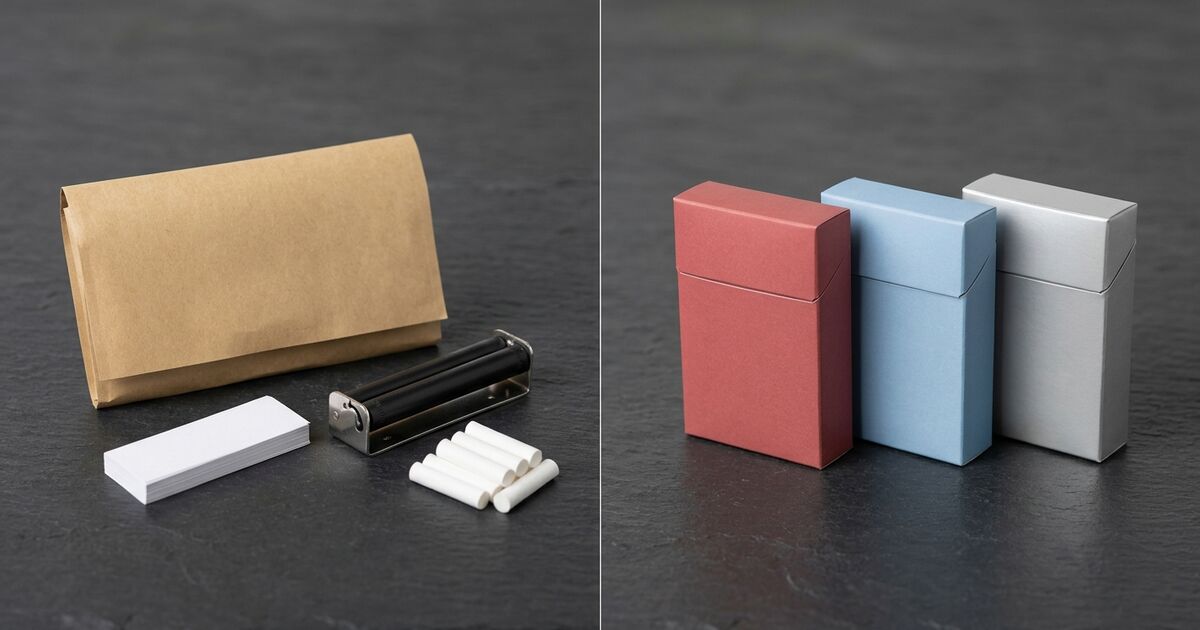
Rolling Tobacco vs Cigarettes Canada: Which Format Fits Your Routine? (2026 Guide)
Comparing rolling tobacco vs cigarettes Canada shoppers usually focus on three practical questions: how much preparation is involved, how consistent each cigarette will be, and how easy it is to choose the right strength. Rolling tobacco gives the user control over each roll. Ready-made cigarettes remove the setup and provide a fixed format from the first cigarette in a pack to the last.
This guide compares the two formats as buying options. It does not assume that one format is right for everyone. Instead, it explains the equipment, time, consistency, brand selection, quantity planning, and storage factors that matter when deciding what to order. If ready-made cigarettes match your priorities, you can compare the current selection in the BCO cigarette catalog or view the complete online shop.
Quick Answer: Rolling Tobacco or Ready-Made Cigarettes?
Choose rolling tobacco when adjusting the amount of tobacco, paper, filter, and finished size is a central part of your preference. Choose ready-made cigarettes when convenience, repeatable construction, and simple brand-to-brand comparison matter more. A ready-made pack is a complete product. Rolling requires loose tobacco plus compatible papers, filters if used, and enough time to assemble each cigarette.
QUICK MATCHING GUIDE
Priority                         Format to compare first
Fast, ready-to-use format        Ready-made cigarettes
Same construction each time      Ready-made cigarettes
Many labelled strength choices   Ready-made cigarettes
Control over each finished roll  Rolling tobacco
No papers or filters to track    Ready-made cigarettes
Custom amount in each cigarette  Rolling tobacco
Easy carton quantity planning    Ready-made cigarettes
Simple brand switching           Ready-made cigarettes
The main decision is therefore not just loose tobacco versus a pack. It is a choice between a component-based routine and a finished product. That distinction affects every part of the purchase.
What You Need for Each Format
Rolling Tobacco Is a Multi-Part Purchase
A rolling setup normally starts with loose tobacco and papers. Some buyers also use separate filters, a rolling machine, a pouch, or a storage container. The exact combination depends on how the person rolls. Running out of any required component can interrupt the routine even when tobacco remains.
This format provides more control, but that control comes with more variables. Paper width, filter size, tobacco amount, packing density, and rolling technique can all change the finished result. Buyers who value that hands-on adjustment may consider the extra steps worthwhile.
Ready-Made Cigarettes Are a Complete Purchase
A ready-made cigarette pack combines the tobacco, paper, filter, and finished construction. The primary buying choices become brand, labelled strength, style, and quantity. There is no need to match separate components or assemble anything before use.
This makes the format easier to reorder. Once a buyer finds a suitable product, the exact SKU can be saved and purchased again. For example, someone who selects Nexus Full Flavor can return to that product instead of recreating a roll from several separate items.
Convenience and Time: The Largest Practical Difference
Rolling takes preparation. Even an experienced roller needs papers, tobacco, and a suitable surface or technique. Wind, limited space, and a busy schedule can make assembly less convenient. Some people prepare several in advance, but that adds another planning step and requires a container that protects the finished rolls.
Ready-made cigarettes are designed around immediate access. The pack travels as one item and each cigarette is already finished. For buyers who want to remove preparation from the routine, this is the clearest advantage. It is also useful when an order is intended for more than one person because nobody needs to agree on rolling supplies or technique.
Convenience can also make trial orders simpler. A buyer can compare two labelled products, such as Putters Full Flavor and Putters Light, without changing papers, filters, or tobacco quantity between tests.
Consistency and Control
Consistency and control sound similar, but they point in different directions. Rolling tobacco offers control over the individual cigarette. Ready-made cigarettes offer consistency across the pack.
Where Rolling Offers More Control
- The user decides how much tobacco goes into each roll.
- The finished length and density can be adjusted.
- Papers and filters can be selected separately.
- Each cigarette can be changed without buying a different labelled variant.
That flexibility is the main reason to choose rolling tobacco. It also means results can vary from one roll to another. Technique, available time, and the condition of the loose tobacco all affect repeatability.
Where Ready-Made Cigarettes Offer More Consistency
- Each cigarette has the same intended dimensions within the product line.
- The paper and filter are already matched to the product.
- There is no variation caused by rolling technique.
- A product name and slug make reordering direct.
For a buyer who wants a repeatable format, a defined SKU is easier to manage. Brand families also make controlled comparisons possible. dM Original and dM Smooth, for example, provide two clearly labelled choices within the same brand rather than an open-ended set of rolling adjustments.
Comparing Strength Is Easier With Labelled Variants
Loose tobacco strength can be affected by the blend, the amount used, the paper, the filter, and how tightly the cigarette is rolled. That gives experienced rollers flexibility, but it can make direct comparison less straightforward.
Ready-made catalogs organize products by labelled variants such as full flavour, light, ultra light, extra light, and menthol. These labels are practical shopping categories, not an exact universal scale across every manufacturer. Even so, they give buyers a useful starting point. The cigarette strength levels guide explains how to compare those tiers across the BCO catalog.
Full-Flavour Choices
Buyers who already know they want the full-flavour tier can compare several direct product options. The catalog includes Classics Full Flavor, Canadian Full, BB Full Flavor, and Rolled Gold Full Flavor. Each is a separate SKU, so a buyer can compare brands while keeping the labelled tier constant.
Other full-flavour products include Playfare Full Flavor, Discount Full Flavor, and DK’s Full. For a wider comparison before ordering, see the full-flavour cigarettes guide.
Light and Lower-Intensity Labelled Choices
For shoppers comparing light-labelled products, options include Nexus Light, Rolled Gold Light, BB Light, and DK’s Light. Buyers seeking another step in the labelled range can review Playfare Ultra Light or Classics Extra Lights.
The light cigarettes Canada comparison groups the available light, ultra-light, and extra-light variants in one place. That kind of catalog-level comparison is much harder with a rolling setup because the finished result depends on multiple components and user technique.
Menthol Choices
Menthol buyers can also shop by a clearly named product. Current examples include Classics Menthol, Canadian Menthol, Rolled Gold Menthol, and Discount Menthol Canadian Blend. The menthol cigarettes buying guide provides a broader product-by-product list.
Brand Choice: Fixed Families Make Comparison Faster
Rolling tobacco buyers often compare loose blends and component combinations. Ready-made buyers can compare brand families. A family keeps the brand name constant while changing the labelled variant, which is useful when a buyer wants to move up or down the range without starting from an unrelated product.
Canadian Cigarettes has a four-product structure covering Full, Lights, Ultra Lights, and Menthol. Classics follows a similar broad structure with Full Flavor, Lights, Extra Lights, and Menthol. These wider families are useful when the buyer’s priority is having several labelled choices under one brand.
Two-product families make the decision even simpler. Putters offers Full Flavor and Light. Nexus offers Full Flavor and Light. Canadian Premium offers Canadian Premium Original and Canadian Premium Special. A buyer who dislikes sorting through a large range may prefer one of these shorter lineups.
For a complete catalog-level view, the Canadian cigarette brands A-Z directory lists the major brand families and links to their available products.
Pack and Carton Planning
Quantity is measured differently in the two formats. Loose tobacco is purchased by its packaged amount, while ready-made cigarettes are organized into packs and cartons. The pack-and-carton structure makes order planning direct because the buyer is choosing a fixed number of finished products rather than estimating how many rolls a pouch may produce.
A pack-sized trial is the practical choice when comparing an unfamiliar strength or brand. A carton is better suited to a product the buyer already knows. This prevents a large order from being committed before the product has been evaluated. The pack versus carton guide covers the main quantity considerations, while the bulk buying guide explains how to plan a larger repeat order.
Buyers who want a discovery-style order rather than selecting a named variant can also review the Mystery Cigarette Pack and Mystery Cigarette Carton. These are separate catalog products and should be considered differently from choosing a specific brand. Select a named SKU when control over the exact product is the priority; choose a mystery option only when the surprise format is intentional.
Cost Comparison Without Guessing at the Final Number
A useful cost comparison needs to include the complete purchase, not only the headline price of tobacco. For rolling, account for loose tobacco, papers, filters if used, replacement supplies, storage, and any rolling device. Also consider how consistently each pouch is portioned. Different roll sizes can change how many finished cigarettes come from the same amount.
For ready-made cigarettes, compare the listed product price, pack or carton quantity, and any current store offer visible at checkout. The quantity is fixed, which makes one order easier to compare with the next. Do not assume that rolling or ready-made will always be the cheaper choice without using current prices and the buyer’s actual consumption pattern.
- Rolling calculation: tobacco plus papers plus filters and accessories, divided by the actual number rolled.
- Ready-made calculation: current pack or carton price divided by the fixed included quantity.
- Trial-order calculation: include the value of avoiding a larger commitment to an untested product.
- Repeat-order calculation: compare the same SKU and quantity across orders.
Because prices and promotions can change, the current shop listing is the correct place to check the ready-made side of the comparison.
Storage and Freshness Planning
Loose tobacco and finished cigarettes both need sensible storage, but the handling is different. Loose tobacco is opened repeatedly and exposed directly whenever a roll is prepared. Papers and filters also need to stay clean, dry, and organized. A rolling kit therefore has several items to protect.
Ready-made cigarettes remain grouped in their original pack and can be managed by pack or carton. Keep the product away from heat, direct sunlight, moisture, and strong surrounding odours. Avoid opening more packs than needed at once. For a complete storage checklist, use the cigarette freshness and storage guide.
Who Is Most Likely to Prefer Ready-Made Cigarettes?
- Routine-focused buyers: people who want the same finished format without assembling each cigarette.
- Brand-specific buyers: people who already know the exact product name they want to reorder.
- Strength-comparison shoppers: people choosing among full flavour, light, ultra light, extra light, or menthol labels.
- Pack and carton planners: people who prefer fixed quantities for trial and repeat orders.
- Buyers who travel between locations: people who do not want to carry loose tobacco, papers, filters, and tools separately.
- Gift buyers: people who need a sealed, identifiable product rather than a collection of rolling components. The cigarette gift guide explains how to choose by known brand and strength.
Who Is Most Likely to Prefer Rolling Tobacco?
- Hands-on users: people who consider rolling part of the routine rather than an unwanted preparation step.
- Custom-size users: people who deliberately change the amount or dimensions of individual rolls.
- Component-specific buyers: people with established preferences for particular paper and filter formats.
- Prepared-kit users: people willing to keep tobacco, papers, filters, and storage together.
The key point is that rolling should be chosen for its customization, not because the extra preparation is being ignored. Buyers who do not use that customization may find that a ready-made product gives them a more direct purchase.
How to Move From Rolling to Ready-Made Cigarettes
A buyer moving from rolling tobacco should avoid selecting a product based only on packaging colour or a broad brand reputation. Use a short matching process instead.
- Identify the usual intensity. Decide whether the current roll is generally closer to a full, light, or very light labelled tier.
- Decide whether menthol is required. This separates menthol products from the standard tobacco-labelled catalog.
- Choose two products in the same tier. Comparing brands at the same labelled strength makes the first test more useful.
- Start with the smaller practical quantity. Test an unfamiliar product before planning a carton order.
- Record the exact SKU. Save the product page rather than relying on memory of a pack colour.
For example, a buyer starting in the light tier could compare Playfare Light with Classics Lights. A buyer starting in full flavour could compare Time Full with Canadian Goose. The goal is not to find a universal winner; it is to narrow the catalog using labelled criteria.
Online Buying Checklist for Ready-Made Cigarettes
- Confirm the full product name, not just the brand.
- Check whether the variant is full flavour, light, ultra light, extra light, or menthol.
- Review the listed quantity before adding the item to the cart.
- Use a smaller trial quantity for an unfamiliar product.
- Use the exact product page for later reorders.
- Keep opened and unopened products stored appropriately after delivery.
- Read the first-time online cigarette buyer’s guide if this is your first BCO order.
Frequently Asked Questions
Are ready-made cigarettes more consistent than hand-rolled cigarettes?
Ready-made cigarettes are intended to provide consistent construction within a product line. Hand-rolled cigarettes can vary with tobacco amount, paper, filter, density, and technique. Rolling offers more individual control, while ready-made products offer more repeatability.
Is rolling tobacco always less expensive?
Not necessarily. A complete comparison must include papers, filters, accessories, storage, the actual number rolled, and current prices. Ready-made products have fixed quantities, which can make per-unit planning easier. Calculate both formats using current purchase details rather than a general assumption.
Which ready-made strength should a roller try first?
Start with the labelled tier closest to the usual roll: full flavour, light, or a lower-intensity label such as ultra light or extra light. Then compare two brands in that tier. If menthol is part of the current preference, start within the menthol category instead.
Should a first order be a pack or carton?
Use a pack-sized trial when the product is unfamiliar. Consider a carton after the exact brand and variant are known. This separates product testing from bulk-order planning.
Where can I compare ready-made Canadian cigarette brands?
Start with the cigarette category for current products, then use the BCO brand directory and strength guides to narrow the list. Product pages provide the exact SKU needed for ordering and reordering.
Final Decision: Custom Assembly or Fixed Convenience?
The rolling tobacco vs cigarettes Canada decision comes down to what the buyer wants to manage. Rolling tobacco provides control over components and each finished roll. Ready-made cigarettes provide a complete format, fixed product names, labelled variants, predictable quantities, and simpler reordering.
If customization is the priority, rolling remains the format to compare. If preparation has become an inconvenience or consistent construction matters more, ready-made cigarettes are the direct alternative. Browse the current Canadian cigarette selection, choose a labelled strength, and test a specific product before planning a larger repeat order.