














 >
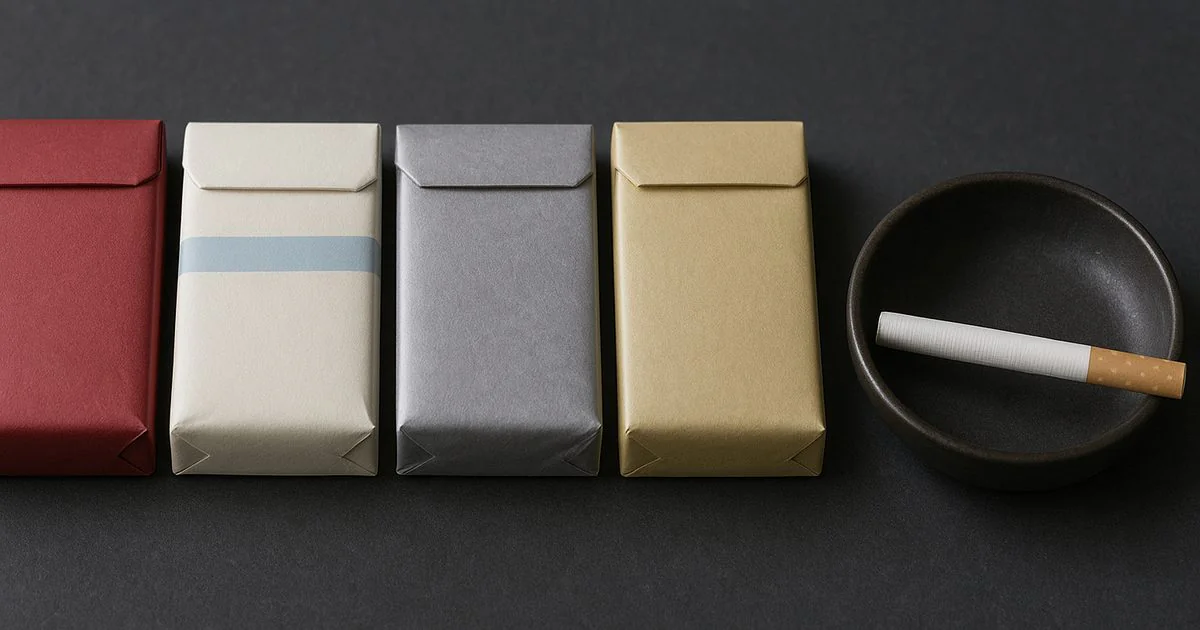
Most smokers have a rough sense of how long a cigarette takes, but almost nobody has counted. That gap matters when you order online, because every buying decision on this site — one pack or a carton, one carton or two — is really a bet on how fast you go through a stick. This guide covers the mechanical side of that question: how long a single cigarette actually lasts, how many draws you get from it, what changes the clock, and how to turn a session length into a realistic pack-and-carton plan.
Quick answer: how long does one cigarette last?
For a standard king-size cigarette, most smokers finish the stick in about five to ten minutes of session time, taking somewhere in the range of eight to fifteen draws. A longer 100s format typically runs a minute or two longer because there is more tobacco in the tube. Those are ranges, not specifications: the same cigarette can take four minutes in wind and twelve minutes sitting still indoors, and both are normal.
The number that matters for ordering is not minutes. It is sticks per day. A pack holds 20 cigarettes, a carton holds 10 packs, so a carton is 200 cigarettes. Once you know your sticks-per-day figure, everything else — packs per week, cartons per month, whether free shipping is worth chasing — falls out of simple arithmetic.
Three different clocks: length, draws, and session time
People mix up three separate measurements when they ask how long a cigarette lasts. Keeping them apart makes the rest of this guide easier to follow.
- Stick length is the physical size of the cigarette. A king size and a 100s are different products, and the format guide on this site covers the differences in detail.
- Draw count is how many pulls you take before the stick is finished. This is the number most affected by how you smoke, not by what you bought.
- Session time is clock time from light to finish. It includes everything you are not doing — resting the stick in the ashtray, talking, checking your phone — and that idle time is where a lot of the tobacco actually goes.
The distinction is practical. Two smokers can each finish a pack a day, but one takes twenty short breaks of three minutes and the other smokes eight longer sessions. Their carton consumption is identical and their session experience is completely different. When you plan an order, plan on sticks.
The four things that change how fast a cigarette burns
1. Paper porosity and how tightly the tobacco is packed
Cigarette paper is deliberately porous: it lets a small amount of air in along the length of the tube so the burn stays even rather than tunnelling down one side. Papers that let more air through tend to keep the cherry moving; a denser, more tightly packed tube tends to hold its heat and burn more slowly per millimetre. This is the main reason a budget blend with a loose fill can feel like it disappears faster than a firm, densely packed stick.
Our own product copy leans on this idea in different words. The Canadian Goose Cigarettes listing describes a “perfect burn, even airflow” construction, while the Nexus Full Flavor Cigarettes page talks about a draw that does not need “hard pulls or constant relighting.” Those are the two failure modes at opposite ends: a stick that races, and a stick that keeps going out.
2. Filter ventilation and filter density
Most modern filters are ventilated — tiny perforations near the mouth end let air in with each draw. A heavily ventilated filter makes the draw feel light and easy, which is exactly the feel the milder tiers are built around. The trade-off is that an easy draw often means more frequent, shorter pulls, so a light cigarette can be finished faster in clock time than a firm full-flavour stick that you draw on less often. This is one reason “lights” do not automatically mean “lasts longer.”
3. Tobacco cut and moisture
A fine cut exposes more surface area and lights and burns more readily; a coarser cut burns a little more slowly and holds an ember better. Moisture matters even more. Tobacco that has been sealed since packing burns slower and cooler than tobacco that has been sitting in an opened pack in a dry room. Winter is the worst season for this: indoor heating pulls moisture out of an open pack within a few days, and a dry stick can burn noticeably faster and harsher than the same cigarette did when fresh.
The blend behind the cut matters too, which is why the same session length feels different across brands. Virginia, Burley and Oriental tobaccos behave differently in the tube; the blend guide explains the difference. If you want the mechanical version of the same question — what the filter, paper and cut are doing inside the stick — the cigarette construction guide covers it.
4. How you draw, and how long the stick rests
This is the biggest variable and the one nobody counts. A cigarette left resting in an ashtray keeps smouldering: tobacco is consumed without a single draw being taken. Long gaps between draws can eat a third of the stick before you have had half your pulls. Wind makes it worse by feeding the ember. Two smokers with identical packs, identical brands and identical habits can differ by three minutes a stick purely on how often they set it down.
How many draws are in one cigarette?
Draw counts cluster more tightly than session times do. A typical king-size stick gives somewhere between eight and fifteen draws depending on pull strength and ventilation. Strong, quick pulls give fewer but hotter draws; light pulls give more, cooler ones. The table below maps the common patterns.
  Draw style        | Draws  | Session time | Notes
--------------------+--------+--------------+---------------------
  Quick, strong     |  6-9   |  3-5 min     | short break pace
  Steady, normal    | 10-13  |  5-8 min     | most common
  Light, frequent   | 14-18  |  8-12 min    | easy-draw filters
  Resting between   | 8-12   | 10-15 min    | smoulder eats stick
  Outdoor / windy   |  6-10  |  3-6 min     | ember runs between
Use these as a planning tool, not a measurement. If you want a real figure, count draws on three cigarettes on three different days and average them. Most people discover they are at the low end of their own estimate, which usually means they are buying less than they need per order.
Why two smokers finish the same pack differently
If you have ever split a carton with someone and watched them run out first, the reasons are almost always behavioural rather than product-related.
- Resting the stick. The single largest difference. Every minute in the ashtray is tobacco gone without a draw.
- Relighting. A stick that goes out and gets relit twice loses tobacco to the relight and tastes worse for the remainder.
- Wind and weather. Outdoor smoking in any season burns faster than indoor smoking. Winter adds the dry-air effect on the pack itself.
- Break length. A three-minute work break produces a different count than a ten-minute sit, even with the same number of cigarettes.
- Variant choice. A firm full-flavour stick and a ventilated light stick pull differently, so the same smoker finishes them at different speeds.
Storage changes the clock
A sealed pack keeps its moisture; an opened one starts losing it immediately. That is why the last three cigarettes in a pack often smoke differently from the first three — drier tobacco burns faster, hotter and harsher. The effect is bigger than most people expect, and it is fully controllable.
Two habits make the biggest difference. First, keep unopened cartons sealed and out of direct heat until you need them. Second, when a pack is open, close it between sessions rather than leaving it open on a counter. The storage guide covers the full routine, and the freshness guide explains how long an unopened pack stays at its best and when a stick is simply past it.
This is also an argument for ordering cartons rather than packs if you smoke steadily: a sealed carton protects its contents better than ten loose packs rattling around a drawer. The carton-buying guide covers when that trade is worth making.
Turning session time into a shopping plan
This is the part that actually changes what you buy. Work through it once and you will never guess at order size again.
Step 1: count sticks per day, not minutes
For three ordinary days, count cigarettes instead of estimating. Most smokers land on a number like 5, 10, 15 or 20. Do not adjust it for a “typical” week — use what you actually smoked.
Step 2: convert to packs per week
Multiply daily sticks by seven, then divide by 20. Ten a day is 70 sticks a week, which is three and a half packs. Twenty a day is 140 sticks, which is exactly seven packs.
Step 3: convert to cartons
A carton is 10 packs and 200 cigarettes. Divide your four-week total by 200:
  Sticks/day | Sticks/4wk | Packs/4wk | Cartons/4wk
-------------+------------+-----------+------------
      5      |    140     |    7.0    |   0.7
     10      |    280     |   14.0    |   1.4
     15      |    420     |   21.0    |   2.1
     20      |    560     |   28.0    |   2.8
     25      |    700     |   35.0    |   3.5
One detail worth knowing before you do this arithmetic: not every carton is configured the same way. The Canadian Goose Cigarettes carton is listed as either 8 packs of 25 or 10 packs of 20, and both come to 200 king-size cigarettes. The pack count inside the carton changes; the cigarette count does not. That is why the table above works in sticks rather than packs.
Step 4: decide pack, carton, or a mixed cart
Pack listings on this site are $5.00 each for most variants, with Rolled Gold Menthol Cigarettes at $6.00. Carton listings run from $29.00 to $38.99. That spread is the whole reason the arithmetic matters: a carton at $38.99 works out to under $4 a pack, and a carton at $29.00 is under $3 a pack, before any free-item tier.
From there the order thresholds do the rest of the work. Flat Rate Expedited shipping is $15 and Flat Rate Xpresspost is $20, and Xpresspost becomes free once the cart clears $99 or, on the post-discount side, $149. If your monthly need is 1.4 cartons, two cartons clears both free-shipping bands comfortably. The shipping guide has the full rate card and the free-shipping guide walks through the threshold behaviour. There are also the three Buy More, Get More tiers — spend $80 and get a free pack, spend $240 and get a free carton, and spend $480 and get two free cartons — which matter if your monthly total already lands near one of those numbers. The bundle guide explains how to build a cart that reaches a tier without stuffing it with products you will not smoke.
If you are close to a threshold, the honest move is not to add a random pack. It is to add the next carton you were going to buy anyway, or to use the gap for a Mystery Cigarette Pack or a Mystery Cigarette Carton if you want to test something without committing to a full carton of a known product. The full monthly-supply walkthrough and the carton-needs math guide both go deeper on this if you want the long version.
Which variants suit a short break and which suit a long sit
Session length is also a product-selection question. If your smoking happens in three-minute gaps between tasks, a firm full-flavour stick is often too much to finish before you have to go back. If your smoking happens in one long sit in the evening, a light, easy-drawing stick tends to run out before you are done. The catalog splits neatly along that line.
Full-flavour sticks for a longer sit
The full-flavour tier across the catalog is described consistently as bold, full-bodied and firm: Canadian Full Cigarettes, Canadian Classics Original, Playfare Full Flavor Cigarettes, BB Full Flavor Cigarettes, Rolled Gold Full Flavor Cigarettes, Discount Full Flavor Cigarettes, Putters Full Flavor, Nexus Full Flavor Cigarettes, dM Original Cigarettes, Classics Full Flavor Cigarettes, Canadian Premium Original, DK’s Full Cigarettes, Time Full Cigarettes and Canadian Goose Cigarettes. If you want one brand family at a time, the Canadian Cigarettes and Canadian Classics archives collect the four-variant lineups in one place.
Lights and smooth variants for quicker breaks
The light tier is where the ventilated, easy-draw construction lives: Canadian Lights, Canadian Classics Silver, Playfare Light Cigarettes, BB Light Cigarettes, Rolled Gold Light Cigarettes, Discount Lights Canadian Blend, Putters Light Cigarettes, Nexus Light Cigarettes, dM Smooth Cigarettes, Classics Lights Cigarettes, Time Blue Cigarettes and DK’s Light Cigarettes. The full Cigarette Brands category lists every variant side by side, and the every-brand light comparison is the fastest way to see the tier across families.
Ultra-lights and menthol
The ultra-light tier — Canadian Ultra Lights, Canadian Classics Ultra Blue, Playfare Ultra Light Cigarettes and Classics Extra Lights Cigarettes — is the lightest draw in the catalog and the tier most likely to be finished quickly if you smoke it in a hurry. Menthol variants — Canadian Menthol Cigarettes, Canadian Classics Menthol, Playfare Menthol Cigarettes, BB Menthol Cigarettes, Discount Menthol Canadian Blend, Rolled Gold Menthol Cigarettes and Classics Menthol Cigarettes — sit at the cool end and are usually smoked at a similar pace to the full-flavour stick they are built on.
Quick match: session length to variant
  Session pattern      | Best-fit tier     | Try first
-----------------------+-------------------+--------------------------------
  3-min work breaks    | Light / ultra     | Canadian Lights, Time Blue
  Normal 5-8 min       | Full or light     | Canadian Full, Playfare Light
  Long evening sit     | Full flavour      | Canadian Classics Original
  Windy outdoor        | Full flavour      | Rolled Gold Full Flavor
  Cold-weather outside | Full flavour      | BB Full Flavor, Canadian Goose
  Alternating sessions | Two-variant cart  | Full + Light same family
  Testing a new brand  | Sampler           | Mystery Pack
Two-variant lineups make this easier than four-variant ones, because there is less to choose between. If you are deciding within a brand family, the four-variant guide and the two-variant guide both break the lineups down by what each variant is actually for.
Common mistakes when estimating consumption
- Counting minutes instead of sticks. Session length varies by up to three times; stick count barely moves. Count what you buy, not how long you hold it.
- Forgetting idle smoulder. A stick that rests is still burning. Smokers who set the cigarette down regularly use more per day than their break count suggests.
- Assuming a carton equals a month. For a 20-a-day smoker a carton is under two weeks. The carton-needs math guide runs the numbers properly.
- Ordering a carton of an unproven variant. A stick that pulls too hard or burns too fast is a 200-cigarette mistake. Start with a pack or a sampler before committing.
- Ignoring seasonal drift. Dry winter air and outdoor smoking both speed up the burn. If your consumption rose in January, the pack may be the reason.
- Never re-measuring. Habits change. Re-count once a season and adjust the standing order size rather than carrying an old number forever.
Frequently asked questions
Does a 100s cigarette last longer than a king size?
Yes, usually by a minute or two, because there is more tobacco in the tube. The difference is smaller than most people expect and is often erased by how you smoke it. The pack sizes guide covers the format differences in detail.
Do light cigarettes burn faster?
They often feel like they do, and for two reasons: a ventilated filter gives an easier, more frequent draw, and a lighter fill can leave a looser tube. It is not a rule, and a firmly packed light stick can outlast a loosely packed full-flavour one.
Do menthol cigarettes burn differently?
Not fundamentally. Menthol changes the feel of the draw, not the burn mechanics. A menthol stick is built on the same base blend as its non-menthol sibling and burns at roughly the same rate.
How long does an opened pack stay at its best?
Days, not weeks, especially indoors in winter with the heat running. A sealed pack holds its moisture far longer than an open one. If you smoke fewer than ten a day, a pack can sit open long enough to go dry — which is an argument for buying packs more often rather than cartons, or for closing the pack properly between sessions. The freshness guide covers the timelines.
Can I work out my monthly carton need from session length?
You can, but it is a two-step. Session length gives you sticks per session; the number of sessions per day gives you sticks per day; sticks per day gives you cartons using 200 per carton. Skipping to minutes-to-cartons directly is where most estimates go wrong.
Plan the order around the count, not the clock
Session time is a comfort question. Consumption is an arithmetic question, and it is the one that decides whether you are paying $5.00 a pack or under $3.00 a pack. Count sticks for three days, convert to cartons at 200 per carton, then let the free-shipping and free-item thresholds decide the rest.
Everything referenced here is in stock in the shop and the Cigarette Brands category, with the full brand list available through the catalog map. If you are not sure which variant to start with, a pack of two or three likely tiers costs less than one carton and answers the question properly.
Related reading: cigarette math for monthly carton needs, buying by the carton, building a restock schedule, storing cigarettes so they stay fresh, the strength guide, pack planning for long shifts, shipping options and shared household orders.