30,000+ Reviews Trusted by Canadian smokers nationwide Use: SMOKE15 for 15% off your purchase today Shop now

Buying Popular Cigarettes Online In Canada

buying popular cigarettes online in canada
⚠️ Legal Notice: This guide is for informational purposes only. Cigarette purchases online must comply with federal and provincial laws. Buyers must be of legal smoking age (18+ or 19+ depending on province) and provide proper age verification.

Buying popular cigarettes in Canada usually refers to purchasing well‑known brands and blends—often Canadian‑made—through either physical retailers or online shops that distribute across provinces and territories. In the online space, many adults look for recognizable Canadian brands, competitive prices, and convenient shipping while staying within the country’s strong public‑health and tobacco‑control framework.

When discussing buying popular cigarettes online, it is important to recognize that tobacco use remains one of the leading preventable causes of disease and premature death in Canada. Public‑health authorities continue to run campaigns, mandatory warnings, and regulatory measures to reduce tobacco use, even as licensed retailers operate within legal rules to serve adults who still choose to smoke.

📊 Comprehensive Cigarette Consumption & Health Impact Infographic

🚬 Smoking Statistics in Canada

  • 5.2 million Canadians smoke regularly (2023)
  • $10.8 billion annual tobacco sales revenue
  • 48,000 smoking-related deaths per year
  • 85% of lung cancer cases linked to smoking
  • $6.5 billion healthcare costs from smoking

💰 Economic Impact

  • $42-85 average carton price online
  • 40-60% savings vs. convenience stores
  • $135-155 typical store carton price
  • $10 billion+ annual industry revenue
  • 500,000+ jobs in tobacco sector

🏥 Health Consequences

  • Heart Disease: 30% increased risk
  • Stroke: 25% increased risk
  • Lung Cancer: 20x higher risk
  • COPD: Major contributing factor
  • Life Expectancy: 10 years shorter on average

📈 Smoking Trends & Demographics

35-54
Peak age group for smoking
22%
Male smoking rate
18%
Female smoking rate
15%
Youth experimentation rate

🎯 Key Takeaways

🚭
Quitting Benefits: Health improvements start within 20 minutes of last cigarette
💊
Support Available: Free quit lines, medications, and counseling across Canada
📊
Regulated Industry: Strict controls on sales, marketing, and product standards
Data sources: Health Canada, Statistics Canada, Canadian Cancer Society, Heart & Stroke Foundation (2023-2024)

Health Risks To Understand Before Buying

Health Canada, the Heart and Stroke Foundation, and the Canadian Cancer Society all make it very clear that smoking carries major health risks affecting nearly every organ. Cigarette smoking is strongly linked to lung cancer, many other cancers, heart disease, stroke, and chronic respiratory diseases such as chronic obstructive pulmonary disease.

Organizations such as Heart & Stroke highlight smoking as a leading risk factor for disability and premature death, and they emphasize that quitting at any age provides significant health benefits. The Canadian Cancer Society reports that tens of thousands of Canadians die each year due to smoking, which is why tobacco control and warning labels remain a national priority.

How Cigarette Regulation Works In Canada

Canada maintains one of the more comprehensive tobacco‑control frameworks in the world, using legislation, packaging rules, age restrictions, and advertising controls to reduce smoking rates. Health Canada’s tobacco and smoking pages explain how regulations cover product labelling, health warnings, promotion limits, and measures designed to protect youth.

Recent regulatory changes include requirements for large pictorial warning labels and, more recently, new rules that print health messages directly on individual cigarettes to make it nearly impossible to avoid seeing warnings. These measures are intended to remind users of the risks at every smoke break and to discourage young people from starting.

Why Some Smokers Choose To Buy Cigarettes Online

Despite the health risks, many adults who already smoke look for more convenient and consistent ways to purchase their usual brands, which is where online cigarette retailers play a role. Buying popular cigarettes online can appeal to smokers who want:

  • Easier access to specific brands that may not be available at every local store.
  • Bulk purchasing options that can lower the per‑pack price.
  • Discreet home delivery, which some retailers explicitly advertise.

If you operate a store such as Buy Cigs Online, pages like:

provide natural internal links when explaining why many Canadian smokers explore online purchasing. These pages can be positioned as educational guides for adults on how the process works, including payment methods, verification, and shipping expectations.

🚬 Popular Canadian Cigarette Brands & Collections Showcase

🇨🇦

Canadian Cigarettes

Broad category of Canadian-market brands, offering traditional and modern options for local preferences.

Popular Products: Canadian Lights, Canadian Regular
Price Range: $42-65 per carton
Shop Now →
👑

Canadian Classics

Well-known line with multiple variants, favored by long-time smokers for consistent quality.

Popular Products: Canadian Classics Original, Menthol, Silver
Price Range: $45-70 per carton
Shop Now →
⭐

Canadian Premium

Positioned for adult smokers seeking premium-profile products with refined taste.

Popular Products: Premium blends, Specialty variants
Price Range: $50-75 per carton
Shop Now →
🏛️

Classics Cigarettes

Additional options under the Classics naming, providing variety within familiar branding.

Popular Products: Classics Regular, Menthol options
Price Range: $40-65 per carton
Shop Now →
💰

Discount Cigarettes

Value-focused options for price-sensitive adult smokers, maintaining quality standards.

Popular Products: Budget-friendly Canadian brands
Price Range: $35-55 per carton
Shop Now →
🦆

Canadian Goose

Another Canadian-market brand line, offering additional choices for local preferences.

Popular Products: Goose Regular, Specialty blends
Price Range: $38-60 per carton
Shop Now →

🎯 Why Choose Canadian Brands?

🌱
Local Production: Made in Canada for freshness and quality control
💼
Regulatory Compliance: Meet strict Canadian standards and health warnings
❤️
Community Support: Jobs and taxes support Canadian economy
🚚
Fast Shipping: Quick delivery across all provinces
All prices are approximate and may vary by retailer. Adult smokers only – 18+ required.

When talking about buying popular cigarettes, Canadian brands and styles deserve a dedicated section, because they reflect local preferences and long‑standing brand recognition. Many smokers look for well‑known Canadian products, including standard, premium, menthol, and value‑focused options.

On Buy Cigs Online, you can highlight your main brand collections and link them contextually:

These collections can be grouped into:

  • “Everyday Canadian favourites” (e.g., Canadian Classics, Canadian Lights).
  • “Premium and smoother profiles” (Canadian Premium, certain Classics blends).
  • “Value and discount options” (Discount Cigarettes, selected Canadian Goose or similar lines).

Spotlight On Canadian Classics And Other Favourites

A dedicated H2/H3 cluster can focus on specific popular products to align with the “buying popular cigarettes” search intent while driving product‑level internal links. Feature each product with short, original descriptions centered on flavour profile, strength, and format—without making health claims or contradicting warnings.

Recommended product spotlights:

How To Start Buying Cigarettes Online In Canada

A practical, step‑by‑step guide section aligns perfectly with the keyword “buying popular cigarettes” and secondary phrases like “Buy Cigarettes Online Canada.” You can outline a general process that responsible retailers follow while maintaining compliance with Canadian regulations and age‑restriction requirements.

Suggested steps:

  • Confirm legal age and provincial rules. Remind readers that in Canada, provinces and territories set minimum ages (usually 18 or 19), and online retailers must not sell to underage customers.
  • Choose a reputable Canadian online cigarette retailer. Mention your main category page: Buy Cigarettes Online Canada and your homepage – Buy Cigs Online.
  • Browse collections and filter for popular cigarettes. Guide users to branded collections such as Canadian Cigarettes, Canadian Classics, and Discount Cigarettes.
  • Add cartons or packs to cart and proceed to checkout. Explain common payment options (often e‑transfer or card) without mentioning any specific provider.
  • Age verification and shipping. Describe how responsible retailers may require proof of age at delivery or through online verification tools, in line with federal and provincial rules.

Highlight typical shipping time frames across Canadian provinces and emphasize discreet, secure packaging when applicable.

For detailed internal linking, you can point users to your guide: How to Buy Cigarettes Online Canada.

Choosing The Right Cigarette For Your Preferences

Many adults buying popular cigarettes online compare options by flavour, strength, filter type, and price before deciding on a carton. Clear product descriptions help them choose more confidently while simultaneously reinforcing that all combustible tobacco carries serious health risks.

Understanding Strength And “Smoothness” (Regular, Light, Silver)

Words like “original,” “light,” “silver,” or “smooth” are used by brands to distinguish taste and branding and do not make cigarettes safe or significantly less harmful. Health agencies warn that switching to lighter‑tasting cigarettes does not significantly lower exposure to many toxic substances compared with regular cigarettes.

Menthol And Flavoured Options

Menthol products, such as Canadian Classics Menthol, are chosen by some adults for their cooling sensation and distinctive flavour. Policymakers, however, have expressed concern that flavoured products can make tobacco more appealing, especially to youth, so some regions impose additional rules on flavours and additives.

Brand Loyalty Versus Exploring New Options

Many smokers maintain loyalty to one or two brands, but online collections make it easier to compare similar cigarettes within categories like Canadian Cigarettes or Canadian Premium Cigarettes. Others may browse Discount Cigarettes or Canadian Goose Cigarettes when they want to explore different price points or profiles while staying within Canadian‑market brands.

Freshness, Storage And “Do Cigarettes Expire?”

When adults buy cigarettes online, freshness is a frequent concern, especially when purchasing multiple cartons at once. Retailers typically manage stock rotation to keep inventory moving, but smokers should still understand basic storage practices to maintain flavour and avoid excessive staleness.

You can link to your dedicated article: Do Cigarettes Expire?

Smoking Vs Vaping: What Current Evidence Says

Some adults considering buying popular cigarettes online may also be wondering whether vaping is a safer alternative or a tool to help quit smoking. Health Canada emphasizes that both smoking and vaping involve health risks, although combustible tobacco generally carries a heavier burden of disease due to tar and combustion‑related toxins.

You can reference your internal article: Is Smoking Cigarettes Better Than Vaping? – 2025

Smoking, Hair Loss And Other Health Concerns

Beyond well‑known diseases like cancer and heart disease, many smokers are curious about how smoking affects appearance, including skin and hair. Research has explored links between smoking, reduced blood flow, and changes in hair quality, although these concerns are secondary compared to the major life‑threatening risks.

You can include an internal link to: Does Smoking Cause Hair Loss? 2025 Research & Facts

Support, Quitting Resources And Harm Reduction

Although this blog focuses on buying popular cigarettes, it is crucial to highlight that quitting smoking delivers large and rapid health benefits at any age. Canadian organizations provide free tools and services to help smokers create quit plans, handle cravings, and stay motivated over time.

Useful external links:

Is it legal to buy cigarettes online in Canada as an adult?

Licensed retailers can sell cigarettes online in Canada as long as they comply with federal and provincial regulations and restrict sales to adults who meet the legal minimum age. These regulations also require clear health warnings, packaging standards, and limits on how tobacco products can be promoted online.

What are some of the most popular Canadian cigarette brands?

Common categories include Canadian Cigarettes, Canadian Classics Cigarettes, Canadian Premium Cigarettes, Classics Cigarettes, Discount Cigarettes, and Canadian Goose Cigarettes, each grouping several related products. These collections allow adult customers to quickly compare different popular cigarettes without searching the entire store.

How can I tell if an online retailer is reputable?

Signs of a reputable retailer include clear contact details, transparent terms and policies, straightforward age‑restriction statements, and secure, well‑explained payment options. Adult smokers can also look for consistent communication about shipping times and tracking, as well as reviews or feedback from other customers.

Can I save money by buying popular cigarettes online?

Some retailers offer carton discounts or promotional pricing that can reduce the per‑pack cost compared with frequent single‑pack purchases in stores. However, health organizations emphasize that smoking leads to substantial long‑term healthcare and productivity costs, making quitting the most cost‑effective option overall.

Where can I read more about tobacco regulations and health warnings?

Readers looking for official information on tobacco regulation and health warnings in Canada can consult Health Canada and the Canadian Cancer Society. Industry‑focused news listings can also provide updates on regulatory changes and wider tobacco‑control trends.

Infographic: Cigarette Consumption Statistics in Canada

According to Newswire Canada, over 5 million Canadians smoke regularly, with tobacco sales exceeding $10 billion annually.

Cigarette consumption infographic

Health Warning Infographic

As per the Canadian Cancer Society, cigarette smoking causes 85% of lung cancer cases in Canada.

Health warning infographic

Does Cigarettes Cause More Harm Than Vaping? A Comprehensive Comparison

Does Cigarettes Cause More Harm Than Vaping

1. Introduction: Understanding the Debate

Does cigarettes cause more harm than vaping? This critical question has become one of the most debated topics in public health circles, medical communities, and among millions of smokers worldwide. The answer to “does cigarettes cause more harm than vaping” is unequivocally yes – extensive scientific research confirms that cigarettes are dramatically more harmful than vaping across virtually every health metric. As vaping continues to gain popularity as an alternative to traditional smoking, understanding the comparative risks between these two nicotine delivery methods is crucial for making informed decisions about your health and wellbeing.

The answer to “does cigarettes cause more harm than vaping” is backed by extensive scientific research and data from leading health organizations globally. In this comprehensive guide, we’ll examine the scientific evidence, health impacts, chemical compositions, and real-world data to provide you with a clear, unbiased comparison between cigarettes and vaping.

Whether you’re a current smoker considering alternatives, a vaper wondering about your choice, someone concerned about a loved one’s smoking habits, or simply seeking factual information about tobacco harm reduction, this article will help you understand the key differences and make evidence-based decisions.

🔍 Quick Answer to “Does Cigarettes Cause More Harm Than Vaping?”

Yes, cigarettes cause significantly more harm than vaping. According to Public Health England, the Royal College of Physicians, and numerous peer-reviewed scientific studies, vaping is estimated to be at least 95% less harmful than smoking traditional cigarettes. However, this doesn’t mean vaping is completely safe – it simply means it poses substantially fewer risks than combustible tobacco products.

The dramatic difference in harm comes primarily from combustion. When you burn tobacco in traditional cigarettes, you create thousands of toxic chemicals and carcinogens. Vaping, on the other hand, heats liquid without combustion, eliminating most of these harmful byproducts.

📊 8 Million deaths annually from cigarette smoking worldwide
🔬 7,000+ chemicals in cigarette smoke
💨 95% less harmful: Vaping vs Smoking

2. Does Cigarettes Cause More Harm Than Vaping? Health Risks Comparison

When examining whether cigarettes cause more harm than vaping, understanding the comprehensive health risks of both options requires examining multiple factors across different body systems and health dimensions. The scientific consensus is clear: cigarettes pose dramatically higher health risks than vaping across virtually every measurable health outcome.

Traditional cigarette smoking is the leading preventable cause of death worldwide, responsible for more than 8 million deaths annually according to the World Health Organization. In Canada alone, smoking kills approximately 48,000 people each year – more than car accidents, alcohol, and illegal drugs combined. These deaths result from a wide range of smoking-related diseases including lung cancer, heart disease, stroke, and chronic obstructive pulmonary disease (COPD).

Vaping, while not without risks, presents a dramatically different health profile. The key difference lies in the absence of combustion – the burning process that creates the vast majority of harmful chemicals in cigarette smoke. When you smoke cigarettes, you’re inhaling the products of tobacco combustion at temperatures exceeding 900°C, which generates thousands of toxic chemicals.
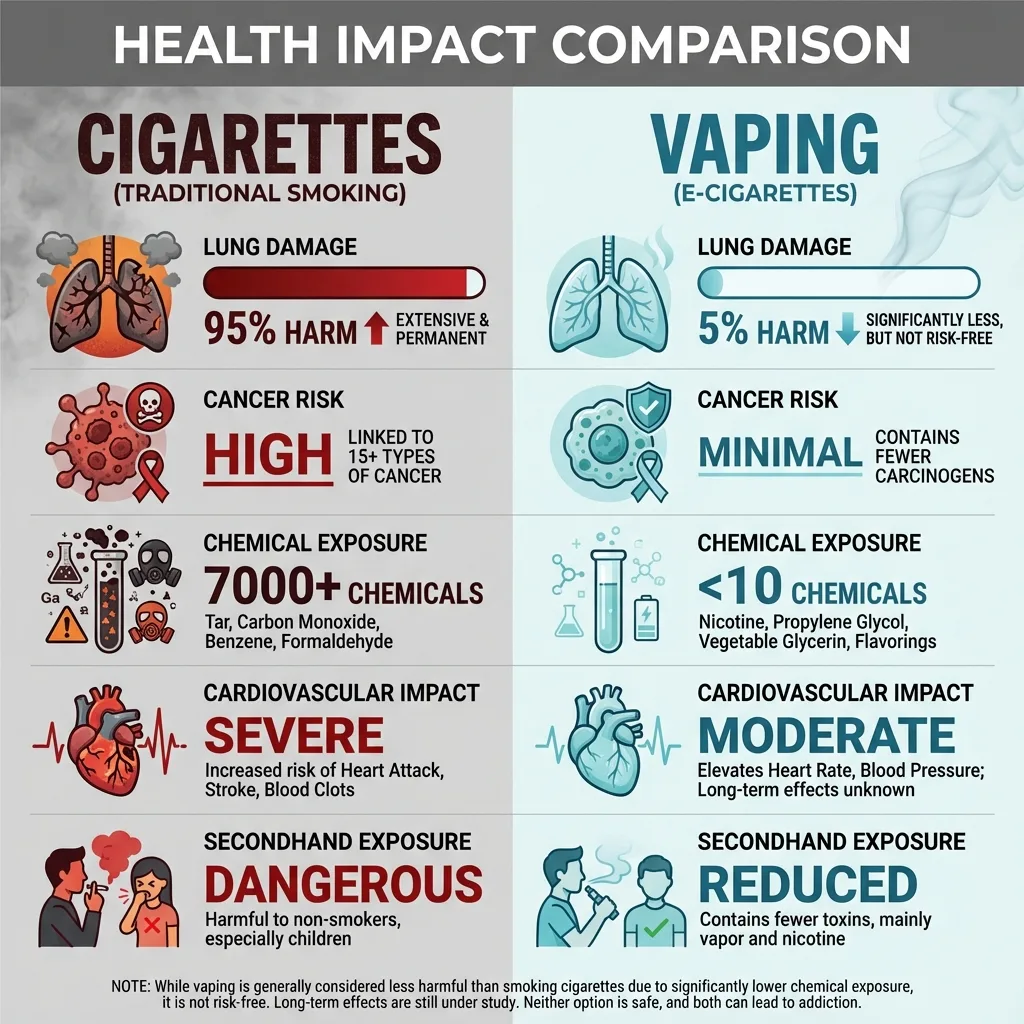
Does cigarettes cause more harm than vaping health comparison infographic
Comprehensive health impact comparison showing relative harm levels between cigarettes and vaping

Overall Health Impact Comparison

The question “does cigarettes cause more harm than vaping” becomes crystal clear when we examine specific health outcomes side by side. Research from multiple countries and health institutions consistently shows that switching from smoking to vaping results in measurable health improvements within weeks to months.

Health Factor Cigarettes Vaping
Overall Harm Level Extremely High (100% baseline) Significantly Lower (5-10% of smoking harm)
Lung Damage Severe – COPD, emphysema, chronic bronchitis guaranteed with long-term use Minimal – Some irritation possible, no evidence of COPD development
Cancer Risk High – 15+ types of cancer directly linked Minimal – No combustion carcinogens present
Heart Disease Risk 2-4x increased risk of heart attack and stroke Lower but not zero – nicotine effects only
Stroke Risk 2-4x increased risk compared to non-smokers Substantially reduced compared to smoking
Respiratory Function Severely impaired over time, irreversible damage Minimal long-term impact, often improvement for switchers
Life Expectancy Impact Average 10-year reduction in lifespan Minimal impact based on current evidence

💡 Key Insight on Why Cigarettes Cause More Harm

The primary difference in harm between cigarettes and vaping comes from combustion. When you burn tobacco in products like menthol cigarettes or full flavor cigarettes, you create thousands of toxic chemicals through the combustion process. These include tar, carbon monoxide, formaldehyde, benzene, and dozens of known carcinogens.

Vaping heats liquid (e-liquid) to create an aerosol without combustion, eliminating the vast majority of these harmful byproducts. This fundamental difference in the mechanism of nicotine delivery is why vaping is substantially less harmful than smoking.

3. Does Cigarettes Cause More Harm Than Vaping? Chemical Composition Analysis

To truly understand whether cigarettes cause more harm than vaping, we need to examine exactly what enters your body with each inhalation. The stark difference in chemical composition between cigarette smoke and vape aerosol is one of the most compelling pieces of evidence explaining why cigarettes are so much more harmful.

When you light a cigarette – whether it’s light cigarettes, ultra-light varieties, or full-flavor options – you initiate a complex combustion process that creates an incredibly toxic chemical cocktail. This isn’t just tobacco smoke; it’s a mixture of over 7,000 different chemicals, many of which are poisonous and at least 70 of which are confirmed carcinogens.
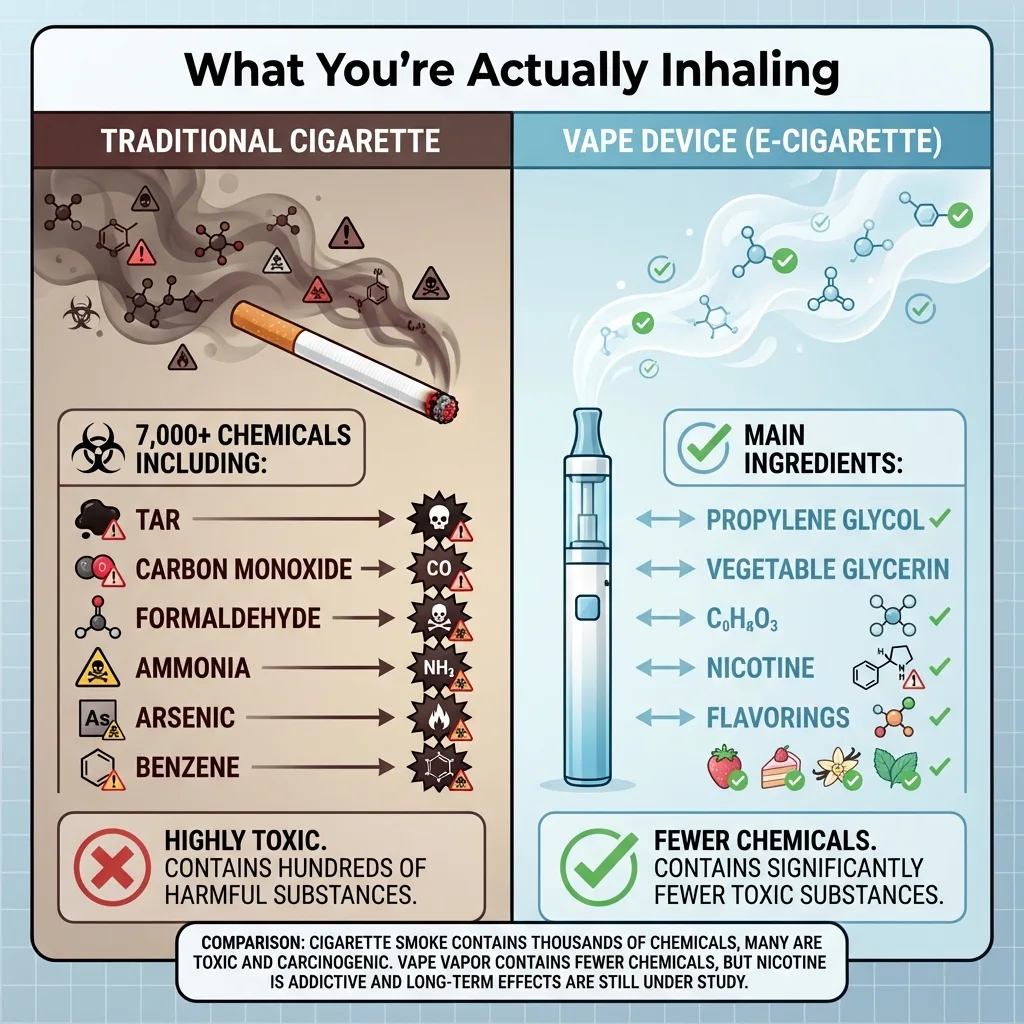
Does cigarettes cause more harm than vaping chemical comparison
Visual breakdown of chemicals in cigarette smoke versus vape aerosol

Cigarette Smoke Chemical Composition

The chemical complexity of cigarette smoke is staggering and provides clear evidence for why cigarettes cause more harm than vaping. Every puff of a cigarette delivers a toxic mixture that affects virtually every organ in your body. Here’s what you’re actually inhaling when you smoke:

  • 7,000+ total chemicals – An enormous mixture including at least 70 known carcinogens and hundreds of toxic substances
  • Tar – A sticky, brown residue that coats your lungs and airways, containing most of the carcinogenic compounds in cigarette smoke
  • Carbon Monoxide – A toxic gas that binds to hemoglobin in your blood, reducing oxygen delivery to vital organs and tissues
  • Formaldehyde – A known carcinogen commonly used in embalming fluid, linked to nasopharyngeal cancer
  • Ammonia – A chemical that manufacturers add to increase nicotine absorption and enhance addiction potential
  • Arsenic – A highly toxic heavy metal that damages DNA and is linked to multiple cancers
  • Benzene – A carcinogen found in gasoline that’s strongly linked to leukemia and other blood cancers
  • Cadmium – A toxic metal that damages kidneys, bones, and the cardiovascular system
  • Hydrogen Cyanide – A deadly poison that damages the cilia in your lungs, making it harder to clear mucus and debris
  • Lead – A neurotoxic heavy metal that accumulates in the body and damages the nervous system
  • Polonium-210 – A radioactive element that accumulates in lung tissue
  • Nitrosamines – Powerful carcinogens formed during tobacco curing and combustion

This is just a partial list of the harmful chemicals in cigarette smoke. Whether you’re smoking BB Full Flavor, Rolled Gold Light, or any other brand, the combustion process creates this toxic mixture. Even “light” or “ultra-light” cigarettes contain these same harmful chemicals – the only difference is slightly reduced tar and nicotine levels, which doesn’t significantly reduce health risks.

Vape Aerosol Chemical Composition

In stark contrast to the thousands of chemicals in cigarette smoke, vape aerosol contains a much simpler chemical profile. This fundamental difference is central to understanding why cigarettes cause more harm than vaping:

  • Propylene Glycol (PG) – An FDA-approved food additive commonly used in food products, cosmetics, and pharmaceutical preparations. It creates the “throat hit” sensation.
  • Vegetable Glycerin (VG) – A natural compound derived from vegetable oils, commonly used in food and cosmetics. It produces the visible vapor.
  • Nicotine – The addictive component, but importantly NOT the primary cause of smoking-related diseases. Available in various concentrations, allowing users to control intake.
  • Flavorings – Food-grade flavor compounds that provide taste. While some flavorings require more research, they’re generally recognized as safe for ingestion.
  • Trace chemicals – Some potentially harmful chemicals can form when e-liquid is heated, but at levels dramatically lower than in cigarette smoke (typically 1-2% of the levels found in cigarettes).

The simplicity of vape aerosol composition compared to cigarette smoke is striking. While vaping isn’t completely harmless, the absence of combustion eliminates the creation of tar, carbon monoxide, and the vast majority of carcinogens found in cigarette smoke.

⚠️ Important Nuance

While vaping contains far fewer chemicals than cigarettes like dM Original or Canadian Goose, it’s not completely harmless. Some flavorings and heating byproducts may pose risks that require ongoing research. However, these potential risks are minimal compared to the well-documented, severe harms of combustible tobacco. The question “does cigarettes cause more harm than vaping” has a clear answer: yes, by a very wide margin.

4. Does Cigarettes Cause More Harm Than Vaping? Respiratory Impact

The respiratory system – your lungs, airways, and breathing apparatus – bears the brunt of smoking-related damage. When evaluating whether cigarettes cause more harm than vaping, the impact on respiratory health provides some of the clearest and most dramatic evidence of the difference between these two nicotine delivery methods.

Your lungs are designed to breathe clean air. When you repeatedly expose them to cigarette smoke from products like BB Light Cigarettes or dM Smooth, you’re subjecting delicate lung tissue to a toxic assault that causes progressive, often irreversible damage. This damage accumulates over time, leading to serious respiratory diseases that dramatically impact quality of life and longevity.

How Cigarettes Devastate Your Respiratory System

Cigarette smoking causes severe, progressive damage to your respiratory system through multiple mechanisms. The hot smoke, toxic chemicals, and particulate matter combine to create a perfect storm of respiratory harm:

  • Chronic Obstructive Pulmonary Disease (COPD) – A progressive, irreversible lung disease that makes breathing increasingly difficult. COPD is almost exclusively caused by smoking and affects millions of people worldwide. It’s the third leading cause of death globally.
  • Emphysema – Permanent destruction of the air sacs (alveoli) in your lungs, reducing your lungs’ ability to absorb oxygen. Once destroyed, these air sacs cannot regenerate.
  • Chronic Bronchitis – Long-term inflammation of the airways causing persistent cough, mucus production, and breathing difficulties. Smokers often experience this “smoker’s cough” daily.
  • Reduced Lung Function – Progressive decrease in lung capacity and efficiency over time. Smokers lose lung function at an accelerated rate compared to non-smokers.
  • Increased Respiratory Infections – Smoking damages the cilia (tiny hair-like structures) that clear mucus and debris from airways, leading to more frequent and severe pneumonia, bronchitis, and other infections.
  • Asthma Exacerbation – Smoking worsens existing asthma and can trigger asthma attacks. It also reduces the effectiveness of asthma medications.
  • Lung Cancer – The leading cause of cancer deaths worldwide, with 85-90% of lung cancer cases caused by smoking.
  • Interstitial Lung Disease – Scarring of lung tissue that impairs breathing and oxygen exchange.

These aren’t theoretical risks – they’re near-certainties for long-term smokers. If you smoke a pack a day of menthol cigarettes or any other type for 20-30 years, you will almost certainly develop significant respiratory impairment. Research on nicotine and tobacco consistently demonstrates these severe health consequences.

Vaping’s Impact on Respiratory Health

When examining whether cigarettes cause more harm than vaping, the respiratory impact comparison is particularly striking. While vaping is not completely without respiratory effects, the difference in severity is dramatic:

  • Mild Irritation – Some users report temporary throat or airway irritation, particularly when first switching from smoking. This typically subsides as the body adjusts.
  • Temporary Cough – Some new vapers experience a cough that usually resolves within a few weeks as the lungs begin to clear accumulated tar and debris from previous smoking.
  • No COPD Association – Current evidence shows no link between vaping and COPD development. This is a crucial distinction from smoking.
  • Improved Function for Switchers – Ex-smokers who switch to vaping often report improved breathing, reduced coughing, better exercise tolerance, and enhanced lung function within weeks to months.
  • Minimal Long-term Damage – Current evidence spanning over 15 years of vaping shows significantly less harm to respiratory function compared to smoking.
  • No Tar Accumulation – Vaping produces no tar, eliminating one of the primary causes of lung damage in smokers.

🎯 Key Takeaway on Respiratory Health

Smokers who switch from traditional cigarettes to vaping often experience dramatic improvements in breathing, reduced coughing, better sleep (less nighttime coughing), and improved physical endurance within just weeks to months. This is one of the most immediate and noticeable health benefits of switching, providing clear evidence that cigarettes cause more harm than vaping.

Many ex-smokers report being able to climb stairs without getting winded, participating in physical activities they’d given up, and no longer waking up coughing. These quality-of-life improvements are significant and measurable.

If you’re concerned about respiratory health and currently smoke cigarettes from any brand, the evidence strongly suggests that switching to vaping would substantially reduce your risk of developing serious, life-threatening lung diseases.

5. Does Cigarettes Cause More Harm Than Vaping? Cardiovascular Effects

Heart disease and stroke are the leading causes of death among smokers, accounting for more smoking-related deaths than lung cancer. Understanding how cigarettes and vaping differently affect your cardiovascular system is essential when evaluating whether cigarettes cause more harm than vaping.

Your cardiovascular system – your heart, blood vessels, and circulatory system – is profoundly affected by smoking. Every cigarette you smoke, whether it’s BB Menthol or any other brand, triggers immediate cardiovascular changes and contributes to long-term damage that dramatically increases your risk of heart attack and stroke.

How Cigarettes Damage Your Cardiovascular System

Cigarette smoking attacks your cardiovascular system through multiple mechanisms, creating a cascade of harmful effects that compound over time:

  • Atherosclerosis – Smoking accelerates the buildup of plaque (fatty deposits) in your arteries, narrowing them and restricting blood flow. This process begins early and worsens with continued smoking.
  • Chronic Blood Pressure Elevation – Smoking causes both immediate and long-term increases in blood pressure, forcing your heart to work harder and damaging blood vessel walls.
  • Increased Blood Clot Formation – Smoking makes your blood “stickier” and more prone to clotting, dramatically increasing the risk of heart attack and stroke.
  • Reduced Oxygen Delivery – Carbon monoxide from cigarette smoke binds to hemoglobin in your blood, reducing oxygen delivery to your heart, brain, and other vital organs.
  • Blood Vessel Damage – Smoking causes inflammation and damage to the endothelium (inner lining) of blood vessels, impairing their ability to dilate and regulate blood flow.
  • Heart Attack Risk – Smokers have 2-4 times higher risk of heart attack compared to non-smokers, with risk increasing with the number of cigarettes smoked daily.
  • Stroke Risk – Smoking doubles to quadruples your risk of stroke, with both ischemic (clot-caused) and hemorrhagic (bleeding) strokes more common in smokers.
  • Peripheral Artery Disease – Reduced blood flow to extremities, potentially leading to pain, tissue damage, and in severe cases, amputation.
  • Aortic Aneurysm – Weakening and bulging of the aorta (main artery), which can rupture with fatal consequences.

These cardiovascular effects occur regardless of which type of cigarettes you smoke. Whether you choose premium brands or budget options, the cardiovascular damage is similar.

Vaping and Cardiovascular Health

The cardiovascular impact of vaping is substantially lower than smoking, though not zero. This difference is central to understanding why cigarettes cause more harm than vaping:

  • Nicotine Effects Only – Vaping delivers nicotine, which causes temporary increases in heart rate and blood pressure, but without the thousands of other cardiovascular toxins found in cigarette smoke.
  • No Carbon Monoxide – Vaping produces no carbon monoxide, eliminating this major cardiovascular toxin that reduces oxygen delivery and damages blood vessels.
  • Reduced Inflammation – Studies show that switchers from smoking to vaping have lower inflammatory markers, indicating reduced cardiovascular stress.
  • Improved Circulation – Ex-smokers who switch to vaping often show improved blood flow and vascular function within weeks.
  • Lower Clotting Risk – Vaping doesn’t increase blood clotting to the same degree as smoking.
  • Significantly Reduced Overall Risk – While not risk-free, vaping poses dramatically lower cardiovascular risk compared to smoking cigarettes.

💡 Research Finding on Cardiovascular Health

A 2019 study published in the Journal of the American College of Cardiology found that smokers who switched completely to vaping showed significant improvements in vascular function within just one month. Blood vessel flexibility improved, inflammatory markers decreased, and overall cardiovascular stress was reduced. This provides strong evidence that cigarettes cause more harm than vaping to your cardiovascular system.

6. Does Cigarettes Cause More Harm Than Vaping? Cancer Risk Analysis

Cancer is one of the most feared consequences of smoking, and for good reason. When asking “does cigarettes cause more harm than vaping,” the cancer risk comparison provides some of the most compelling evidence. Cigarettes are directly and conclusively linked to at least 15 different types of cancer, making smoking the leading preventable cause of cancer worldwide.

The cancer-causing potential of cigarettes comes primarily from the combustion process. When you burn tobacco – whether in Canadian Classics or any other brand – you create dozens of known carcinogens (cancer-causing substances) that damage DNA, trigger mutations, and promote tumor growth throughout your body. Studies on menthol cigarettes in Canada and tobacco harm research provide extensive evidence of these carcinogenic effects.

Cigarette-Related Cancers: A Comprehensive List

Smoking doesn’t just cause lung cancer – it’s linked to cancers throughout your entire body. The carcinogens in cigarette smoke enter your bloodstream and affect organs far from your lungs:

  • Lung cancer – The leading cause of cancer death worldwide, with 85-90% of cases caused by smoking
  • Throat and larynx cancer – Direct exposure to smoke causes high rates of these cancers in smokers
  • Mouth and lip cancer – Oral cancers are dramatically more common in smokers
  • Esophageal cancer – Smoking increases risk 2-4 times
  • Bladder cancer – Carcinogens filtered through kidneys concentrate in urine
  • Kidney cancer – 30-40% higher risk in smokers
  • Pancreatic cancer – One of the deadliest cancers, strongly linked to smoking
  • Stomach cancer – Increased risk even with moderate smoking
  • Liver cancer – Smoking compounds other liver cancer risk factors
  • Cervical cancer – Smoking increases risk in women with HPV
  • Colorectal cancer – Long-term smoking significantly increases risk
  • Acute myeloid leukemia – Blood cancer linked to smoking
  • Nasal cavity and sinus cancer – Rare but strongly associated with smoking
  • Ovarian cancer – Increased risk in female smokers
  • Breast cancer – Emerging evidence suggests increased risk

This extensive list demonstrates that smoking affects cancer risk throughout your entire body, not just your lungs. The carcinogens in smoke from any cigarette brand cause systemic damage.

Vaping and Cancer Risk: What the Evidence Shows

The cancer risk from vaping is dramatically lower than smoking, providing clear evidence that cigarettes cause more harm than vaping. Here’s why:

  • No Combustion – Vaping eliminates the combustion process that creates tar and most carcinogens in cigarette smoke
  • No Tobacco Burning – Without burning tobacco, vaping avoids creating the cancer-causing compounds formed at high temperatures
  • Minimal Carcinogens – While some trace carcinogens may be present in vape aerosol, they’re at levels 1-2% of those found in cigarette smoke
  • No Tar – Tar contains most of the carcinogenic compounds in cigarette smoke; vaping produces no tar
  • Long-term Data – Over 15 years of vaping data shows no evidence of cancer clusters among vapers
  • Biomarker Studies – Research shows dramatically reduced exposure to carcinogens in vapers compared to smokers

⚠️ Important Context on Long-term Cancer Risk

While vaping appears to have minimal cancer risk compared to smoking, it hasn’t been around long enough for 30-40 year longitudinal cancer studies. However, based on the chemical composition analysis, absence of combustion, and current epidemiological data, the cancer risk from vaping is expected to remain far lower than from cigarettes.

For those looking to reduce cancer risk while still using nicotine, switching from any cigarette brand to vaping represents a significant harm reduction strategy backed by current scientific evidence.

7. Addiction Potential and Nicotine Delivery

Understanding addiction potential is crucial when comparing whether cigarettes cause more harm than vaping. Both cigarettes and vaping devices deliver nicotine, which is an addictive substance, but the delivery mechanisms, absorption rates, and overall addiction profiles differ significantly between the two.

Nicotine itself, while addictive, is not the primary cause of smoking-related diseases. The harm from cigarettes comes predominantly from the thousands of toxic chemicals created through combustion, not from nicotine alone. This distinction is important when evaluating the comparative harm of cigarettes versus vaping.

Nicotine Delivery in Cigarettes

Cigarettes deliver nicotine rapidly and efficiently through combustion:

  • Rapid absorption – Nicotine from cigarette smoke reaches the brain within 10-20 seconds, creating an immediate “hit” that reinforces addiction
  • Additional addictive compounds – Cigarettes contain MAO inhibitors and other chemicals that enhance nicotine’s addictive properties
  • Behavioral reinforcement – The ritual of smoking, combined with rapid nicotine delivery, creates strong behavioral patterns
  • Engineered addiction – Tobacco companies have historically manipulated nicotine levels and added ammonia compounds to increase addiction potential

Nicotine Delivery in Vaping

Vaping delivers nicotine differently than cigarettes:

  • Adjustable nicotine levels – Vapers can choose their nicotine concentration, from high levels (similar to cigarettes) down to zero nicotine
  • Slower absorption – Nicotine from vaping is generally absorbed more slowly than from cigarettes, though newer devices have improved delivery
  • No additional addictive enhancers – Vaping lacks the MAO inhibitors and other compounds found in cigarettes that enhance addiction
  • Gradual reduction possible – Many ex-smokers use vaping to gradually reduce nicotine intake over time

While both cigarettes and vaping can be addictive due to nicotine, the question “does cigarettes cause more harm than vaping” extends beyond addiction to overall health impact. The addiction to nicotine is separate from the harm caused by toxic chemicals in cigarette smoke.

8. Does Cigarettes Cause More Harm Than Vaping? Cost Comparison in Canada

Beyond the critical health considerations when evaluating whether cigarettes cause more harm than vaping, the financial impact is substantial and worth examining. In Canada, where tobacco taxes are among the highest in the world, the cost difference between smoking and vaping can amount to thousands of dollars annually – money that could be used for savings, debt reduction, family needs, or quality of life improvements.

The high cost of cigarettes in Canada is intentional – it’s a public health measure designed to discourage smoking and offset healthcare costs associated with smoking-related diseases. While this makes cigarettes expensive, it also makes the financial case for switching to vaping even more compelling.
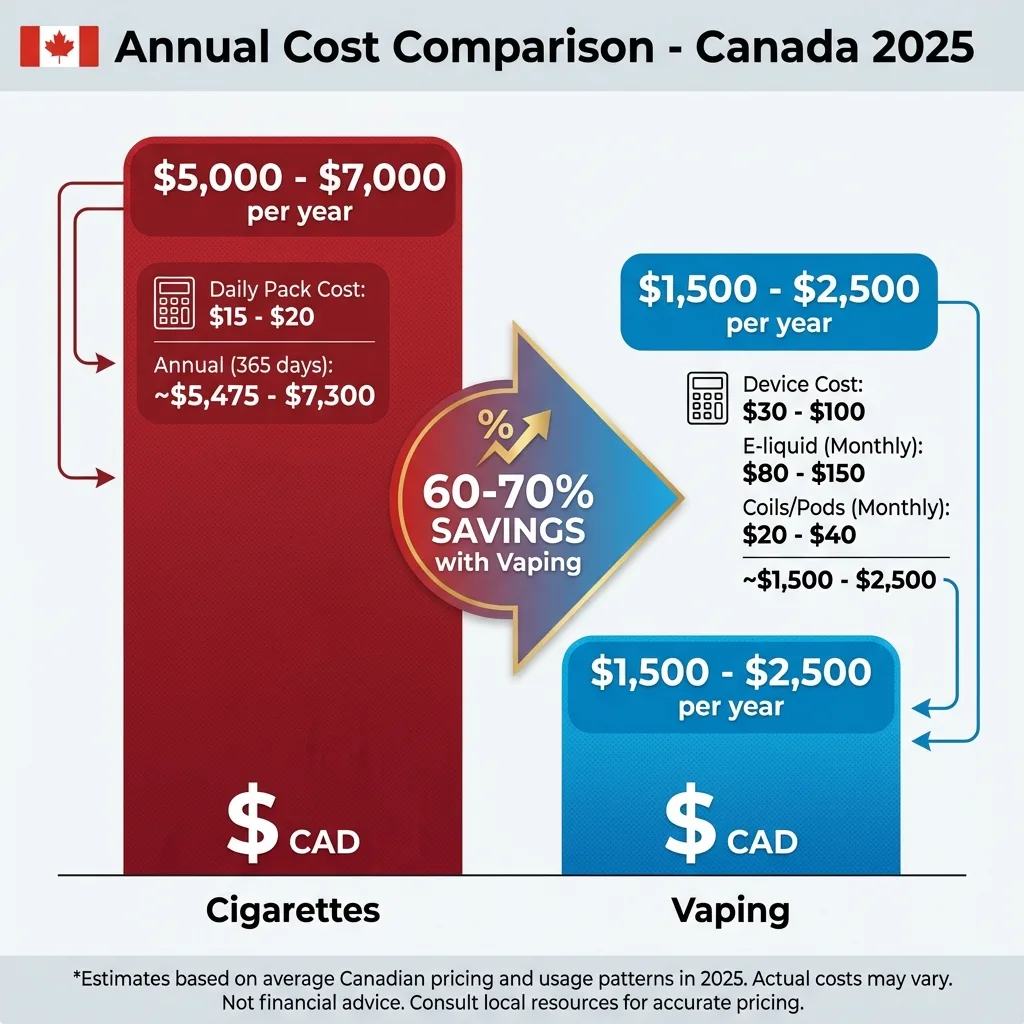
Does cigarettes cause more harm than vaping cost analysis Canada
Financial comparison showing potential savings from switching to vaping in Canada

Annual Cost of Smoking Cigarettes in Canada (2025)

The cost of smoking in Canada varies by province due to different tax rates, but it’s expensive everywhere. Here’s what smokers can expect to spend annually:

  • Pack-a-day smoker – $5,000 to $7,000 per year (based on $14-20 per pack)
  • Half-pack daily smoker – $2,500 to $3,500 per year
  • Two packs daily smoker – $10,000 to $14,000 per year
  • Occasional smoker (5 packs/week) – $3,500 to $5,000 per year

These costs apply whether you’re buying Classics Full Flavor, Nexus, or any other brand. Even when you buy cigarettes online at bulk discounts, the annual costs remain substantial.

Annual Cost of Vaping in Canada (2025)

Vaping has a different cost structure with higher upfront costs but lower ongoing expenses:

  • Initial device cost – $50 to $150 (one-time investment, though devices may need replacement every 1-2 years)
  • E-liquid for regular user – $1,200 to $2,000 per year (depending on usage and whether you buy premium or budget brands)
  • Replacement coils/pods – $300 to $500 per year (varies by device type)
  • Battery replacements – $20 to $50 per year (if needed)
  • Total annual cost – $1,500 to $2,500 per year after initial setup

💰 Potential Annual Savings

A pack-a-day smoker switching to vaping could save $3,000 to $5,000 annually! Over five years, that’s $15,000 to $25,000 in savings – enough for a down payment on a car, significant debt reduction, a family vacation fund, or substantial retirement savings.

Even half-pack-a-day smokers can save $1,000 to $2,000 per year by switching. These aren’t trivial amounts – they represent real financial relief that can improve quality of life and financial security.

While cost shouldn’t be the primary factor in health decisions, the financial benefits of switching are undeniable and provide additional motivation beyond the health improvements. When you combine the fact that cigarettes cause more harm than vaping with the significant cost savings, the case for switching becomes even more compelling.

9. Does Cigarettes Cause More Harm Than Vaping? Long-Term Effects

Understanding the long-term trajectory of health impacts is crucial when comparing whether cigarettes cause more harm than vaping. The progression of smoking-related diseases follows a predictable pattern, with damage accumulating over years and decades. In contrast, vaping shows a dramatically different long-term health profile.
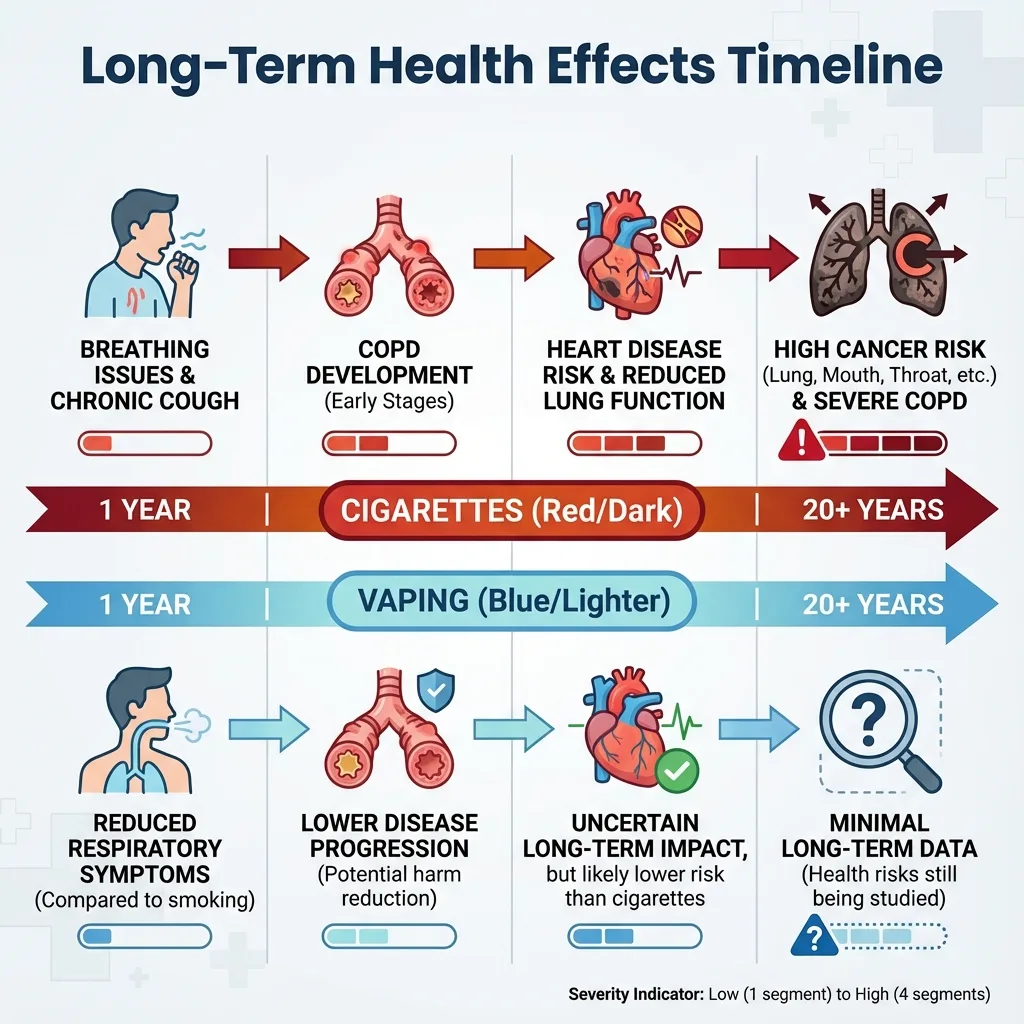
Does cigarettes cause more harm than vaping long-term health timeline
Comparative timeline of health effects over years of use

Long-term Cigarette Smoking Effects: A Progressive Decline

Smoking causes cumulative damage that worsens over time. Whether you smoke light cigarettes or full-flavor varieties, the long-term health trajectory is similar, though heavy smokers experience faster progression:

After 1 Year of Smoking:

  • Persistent cough and increased phlegm production, especially in the morning
  • Reduced lung capacity and exercise tolerance
  • Increased susceptibility to colds, flu, and respiratory infections
  • Elevated blood pressure and heart rate
  • Reduced sense of taste and smell
  • Premature skin aging begins
  • Teeth yellowing and gum problems

After 5 Years of Smoking:

  • Significant measurable decline in lung function
  • Early signs of COPD may be detectable
  • Increased cardiovascular disease risk markers
  • Premature skin aging becomes noticeable
  • Chronic cough becomes persistent
  • Reduced physical endurance and stamina
  • Increased frequency of respiratory infections

After 10 Years of Smoking:

  • COPD diagnosis becomes common
  • Substantially increased cancer risk across multiple organ systems
  • Heart disease development likely
  • Reduced life expectancy becomes statistically significant
  • Chronic health problems affect daily quality of life
  • Lung function may be reduced by 25-30%
  • Cardiovascular system shows significant damage

After 20+ Years of Smoking:

  • Severe COPD often requiring supplemental oxygen therapy
  • High incidence of cancer diagnoses
  • Multiple cardiovascular events (heart attacks, strokes) common
  • Average 10-year reduction in lifespan
  • Severely compromised quality of life
  • Multiple chronic diseases requiring ongoing medical care
  • Significant disability and reduced independence

This progression occurs regardless of which cigarettes you smoke. The brand doesn’t matter – the combustion process and resulting toxins cause similar damage whether you smoke premium or budget cigarettes.

Long-term Vaping Effects: Current Evidence

Vaping hasn’t been around as long as cigarettes, so we don’t have 40-50 year longitudinal data. However, the evidence we do have spanning 15+ years shows a dramatically different health profile, supporting the conclusion that cigarettes cause more harm than vaping:

Current Evidence (up to 15 years of vaping):

  • No evidence of COPD development in vapers who never smoked
  • No cancer clusters identified in vaping populations
  • Minimal respiratory symptoms compared to smokers
  • Improved health markers for ex-smokers who switched to vaping
  • No significant increase in cardiovascular disease
  • No evidence of the progressive lung function decline seen in smokers
  • Biomarker studies show dramatically reduced exposure to toxins
  • Population studies show no increase in serious disease rates

💡 Research Limitation and Projection

Vaping has only been widely used for about 15 years, so we don’t have 30-40 year longitudinal data like we do for cigarettes. However, based on chemical analysis, absence of combustion, current epidemiological evidence, and biomarker studies, the long-term risks of vaping appear to be minimal compared to smoking.

The fundamental difference – no combustion – means vaping avoids creating the thousands of toxic chemicals that cause the progressive diseases seen in smokers. This provides strong scientific basis for expecting that long-term vaping will remain substantially less harmful than smoking.

10. Secondhand Exposure Risks

When evaluating whether cigarettes cause more harm than vaping, the impact on bystanders and family members is an important consideration. Secondhand smoke from cigarettes is a well-documented health hazard, while secondhand vapor exposure presents a dramatically different risk profile.

Secondhand Cigarette Smoke Dangers

Secondhand cigarette smoke is classified as a Group 1 carcinogen by the WHO and contains over 7,000 chemicals:

  • Cancer risk – Secondhand smoke causes lung cancer in non-smokers, with no safe level of exposure
  • Cardiovascular disease – Increases heart disease risk in non-smokers by 25-30%
  • Respiratory problems – Triggers asthma attacks and causes respiratory infections, especially in children
  • Childhood impacts – Linked to SIDS, ear infections, and developmental issues in children

Secondhand Vapor Exposure

Secondhand vapor from e-cigarettes contains far fewer harmful chemicals:

  • Minimal chemical exposure – Contains primarily propylene glycol, vegetable glycerin, and nicotine traces
  • No combustion products – Lacks the tar, carbon monoxide, and carcinogens found in cigarette smoke
  • Rapid dissipation – Vapor particles dissipate quickly and don’t linger like cigarette smoke
  • Lower risk profile – Current evidence suggests minimal health risk to bystanders

The question “does cigarettes cause more harm than vaping” extends to those around you. Switching from cigarettes to vaping dramatically reduces exposure risks for family members, coworkers, and others in your environment.

11. Quitting Success Rates

Understanding cessation success rates helps answer whether cigarettes cause more harm than vaping from a practical harm reduction perspective. If vaping helps smokers quit combustible tobacco, it serves as an effective harm reduction tool.

Traditional Quitting Methods Success Rates

  • Cold turkey – 3-5% success rate after one year
  • Nicotine patches – 8-10% success rate
  • Nicotine gum – 6-8% success rate
  • Prescription medications – 10-15% success rate

Vaping as a Cessation Tool

Recent studies show vaping may be more effective for smoking cessation:

  • Higher success rates – Studies show 15-20% success rates for complete smoking cessation
  • Behavioral similarity – Mimics the hand-to-mouth action and ritual of smoking
  • Gradual nicotine reduction – Allows users to step down nicotine levels over time
  • Immediate harm reduction – Even if not quitting nicotine entirely, switching eliminates most smoking-related harm

While the ideal outcome is quitting all nicotine use, vaping provides a less harmful alternative for those who cannot or will not quit entirely, clearly demonstrating that cigarettes cause more harm than vaping.

12. Canadian Regulations and Perspective

Canada’s regulatory approach to cigarettes and vaping reflects the understanding that cigarettes cause more harm than vaping, while still maintaining appropriate controls on both products.

Canadian Cigarette Regulations

  • Heavy taxation – High taxes designed to discourage smoking and offset healthcare costs
  • Plain packaging – Standardized packaging with graphic health warnings covering 75% of package surface
  • Sales restrictions – Minimum age of 18-19 (varies by province), no sales in pharmacies
  • Advertising bans – Comprehensive restrictions on tobacco advertising and promotion

Canadian Vaping Regulations

  • Regulated under Tobacco and Vaping Products Act – Framework balancing access for adult smokers with youth protection
  • Age restrictions – Minimum age 18-19 depending on province
  • Nicotine limits – Maximum 20mg/mL nicotine concentration
  • Health warnings required – Products must carry health warnings about nicotine addiction
  • Flavor restrictions – Some provinces have restricted flavored vaping products

Health Canada’s position acknowledges that while vaping is not without risks, it is significantly less harmful than smoking cigarettes, supporting harm reduction approaches for current smokers.

13. Current Scientific Evidence (2025)

The scientific consensus on whether cigarettes cause more harm than vaping is clear and supported by extensive research from leading health organizations worldwide.

Major Health Organization Positions

  • Public Health England – States vaping is 95% less harmful than smoking
  • Royal College of Physicians (UK) – Supports vaping as a harm reduction tool for smokers
  • Health Canada – Acknowledges vaping is less harmful than smoking while not risk-free
  • American Cancer Society – Recognizes vaping as less harmful than combustible tobacco

Key Research Findings (2020-2025)

  • Biomarker studies – Show 90-95% reduction in exposure to harmful chemicals when switching from smoking to vaping
  • Cardiovascular research – Demonstrates improved vascular function in switchers within weeks
  • Respiratory studies – Show no evidence of COPD development in long-term vapers
  • Population studies – No increase in serious disease rates among vaping populations
  • Cessation research – Indicates vaping may be more effective than traditional NRT for smoking cessation

The overwhelming scientific evidence confirms that cigarettes cause more harm than vaping across every measurable health outcome, making vaping a viable harm reduction option for smokers unable or unwilling to quit nicotine entirely.

14. Conclusion: The Definitive Answer

After examining comprehensive evidence across health impacts, chemical composition, long-term effects, cardiovascular risks, cancer potential, respiratory damage, and scientific research from leading health organizations worldwide, we can definitively answer the question: Does cigarettes cause more harm than vaping? Yes, absolutely and unequivocally.

Cigarettes are far more harmful than vaping by virtually every measurable health metric. The evidence is overwhelming, consistent, and comes from multiple independent sources including Public Health England, the Royal College of Physicians, Health Canada, and numerous peer-reviewed scientific studies.

Key Conclusions on Cigarettes vs Vaping Harm

🎯 The Bottom Line: Does Cigarettes Cause More Harm Than Vaping?

  • Cigarettes are far more harmful – Causing millions of deaths annually through cancer, heart disease, COPD, and other smoking-related illnesses
  • Vaping is significantly less harmful – Estimated 95% less harmful than smoking according to Public Health England
  • Switching saves lives – Smokers who completely switch to vaping experience substantial, measurable health improvements within weeks to months
  • Neither is completely safe – The best choice for health is to use neither cigarettes nor vaping, but vaping is clearly the lesser harm for those who use nicotine
  • Harm reduction works – For those unable or unwilling to quit nicotine entirely, vaping offers a much safer alternative to smoking
  • The difference is combustion – Burning tobacco creates thousands of toxic chemicals; vaping’s lack of combustion eliminates most of these harms

Who Should Consider Switching from Cigarettes to Vaping?

Based on the clear evidence that cigarettes cause more harm than vaping, these groups should seriously consider switching:

  • Current smokers of any brand – whether Classics Extra Lights, BB Full Flavor, or any other cigarette – looking to reduce health risks
  • Those who have tried and failed to quit smoking with other methods like nicotine patches, gum, or cold turkey
  • Smokers concerned about family exposure to dangerous secondhand smoke
  • People looking to save significant money (thousands annually) while reducing harm
  • Anyone wanting to improve respiratory function, cardiovascular health, and overall wellbeing
  • Smokers experiencing early symptoms of smoking-related disease who want to prevent further damage
  • Parents who smoke and want to reduce health risks to themselves and secondhand exposure to their children

Who Should Avoid Both Cigarettes and Vaping?

  • Non-smokers and people who don’t currently use nicotine – don’t start either
  • Pregnant women – nicotine can affect fetal development
  • Youth and adolescents – developing brains are more susceptible to nicotine addiction
  • People with certain heart conditions – consult your doctor before using any nicotine product
  • Those with severe respiratory conditions – discuss with healthcare provider

⚠️ Important Reminder

This article answers “does cigarettes cause more harm than vaping” for informational and harm reduction education purposes. The healthiest choice is to avoid both cigarettes and vaping entirely. If you don’t currently smoke or vape, don’t start either one.

However, if you do smoke cigarettes – whether Canadian Classics Menthol, Rolled Gold, or any other brand – the scientific evidence clearly shows that switching to vaping can significantly reduce your health risks. Quitting all nicotine use entirely remains the ideal goal.

Making Your Decision: Does Cigarettes Cause More Harm Than Vaping?

If you’re a current smoker, the evidence overwhelmingly supports switching to vaping as a harm reduction strategy. While vaping isn’t without risks, those risks are minimal compared to the well-documented, severe, and often fatal harms caused by cigarette smoking.

Consider your priorities when deciding:

  • Health – Vaping dramatically reduces disease risk across cancer, heart disease, COPD, and other smoking-related illnesses
  • Cost – Vaping saves thousands of dollars annually compared to smoking cigarettes in Canada
  • Family – Vaping eliminates dangerous secondhand smoke exposure to loved ones
  • Quality of life – Improved breathing, restored sense of taste and smell, better physical endurance, and increased energy
  • Longevity – Reduced risk of premature death and increased healthy years of life

For more information about cigarette products, storage, and related topics, explore our other comprehensive guides including cigarette expiration and freshness and buying cigarettes online in Canada.

Ready to Make an Informed Choice?

Now that you understand that cigarettes cause more harm than vaping, you can make evidence-based decisions about your health. Whether you’re looking for information about traditional cigarettes or considering harm reduction alternatives, we’re here to provide factual information.

Browse Cigarette Products Learn More About Alternatives

📚 Related Articles on Cigarettes and Harm Reduction

Final Answer: Does cigarettes cause more harm than vaping? Yes, the scientific evidence is clear and overwhelming. Cigarettes cause dramatically more harm than vaping across every health metric examined. While the healthiest choice is to avoid both, for current smokers, switching to vaping represents a significant harm reduction opportunity backed by extensive scientific research.

Do Cigarettes Expire? Complete Guide to Cigarette Freshness, Shelf Life & Storage

do cigarettes expire

In today’s fast-paced world, where consumers are increasingly conscious about product quality and freshness, the question “do cigarettes expire” has become a topic of significant interest among smokers and tobacco enthusiasts alike. As one of Canada’s leading online tobacco retailers, Buy Cigs Online Co understands the importance of providing not just premium cigarette brands, but also comprehensive information about maintaining optimal cigarette freshness and understanding cigarette shelf life. This comprehensive guide delves deep into the science of tobacco aging, storage best practices, and the factors that influence how long your cigarettes remain at their peak quality.

When you purchase cigarettes, whether online or from traditional retailers, you’re investing in an experience that combines flavor, aroma, and satisfaction. However, unlike perishable food items that clearly indicate expiration dates, cigarettes follow a more nuanced aging process that affects quality rather than safety. Understanding “do cigarettes expire” requires exploring the complex interplay between tobacco chemistry, environmental factors, and storage conditions. At Buy Cigs Online Co, we believe that educated consumers make better purchasing decisions, which is why we’ve created this definitive resource on cigarette expiration, storing cigarettes properly, and ensuring you always enjoy fresh cigarettes online.

The tobacco industry has evolved significantly over the years, with manufacturers and retailers alike recognizing the importance of freshness in maintaining customer satisfaction. While cigarettes don’t carry the same strict expiration labels as dairy products or medications, industry experts and regulatory bodies have established guidelines for optimal cigarette shelf life. These recommendations, combined with practical storage tips and consumer education, form the foundation of our comprehensive approach at Buy Cigs Online Co. Whether you’re a casual smoker looking to maximize your enjoyment or someone researching the best ways to maintain cigarette quality, this guide provides the insights you need to make informed decisions about your tobacco purchases.

As we explore the intricacies of cigarette freshness and address the fundamental question of “do cigarettes expire,” we’ll examine the scientific principles behind tobacco degradation, the environmental factors that accelerate aging, and the practical steps you can take to preserve your cigarettes’ quality. Our analysis draws from industry standards, expert recommendations, and real-world consumer experiences to provide a complete picture of cigarette longevity. At Buy Cigs Online Co, we don’t just sell cigarettes – we educate our customers about the products they enjoy, ensuring that every purchase delivers the satisfaction and quality you expect from premium tobacco products.

The journey to understanding cigarette expiration begins with recognizing that tobacco is a natural product subject to the same aging processes as other organic materials. Moisture content, chemical composition, packaging integrity, and environmental conditions all play crucial roles in determining how long your cigarettes maintain their optimal characteristics. Through this detailed exploration, we’ll address common misconceptions about expired cigarettes, provide evidence-based storage recommendations, and offer practical advice for buying and maintaining fresh cigarettes online. Our commitment at Buy Cigs Online Co extends beyond the point of sale, encompassing comprehensive customer education that empowers you to make the most of your tobacco purchases.

🚬 Key Facts About Cigarette Expiration & Freshness

  • Cigarettes don’t have strict expiration dates like perishable foods
  • Quality degrades over time due to tobacco drying and chemical changes
  • Proper storage can extend cigarette shelf life for 1-2 years
  • Fresh cigarettes provide better taste, aroma, and smoking experience
  • Buy Cigs Online Co guarantees freshness on every order
  • Industry recommends consuming cigarettes within 2 years of manufacture
  • Humidity and temperature are critical factors in cigarette preservation

1. Introduction: do cigarettes expire

Have you ever wondered do cigarettes expire? As an experienced smoker or someone researching tobacco products, understanding cigarette freshness is crucial for enjoying the best possible smoking experience. At Buy Cigs Online Co, we specialize in providing premium, fresh cigarettes that deliver the quality and satisfaction our customers deserve.

In this comprehensive guide, we’ll explore everything you need to know about cigarette freshness, cigarette shelf life, and how to maintain optimal quality. Whether you’re asking “do cigarettes expire” or looking for tips on storing cigarettes properly, this article covers it all with detailed insights backed by industry knowledge and expert recommendations.

We’ll also address common misconceptions about expired cigarettes and provide practical advice for buying fresh cigarettes online. Our goal is to help you make informed decisions about your tobacco purchases while ensuring you get the best value and experience possible.

2. Understanding Cigarette Freshness Basics

Before diving into whether do cigarettes expire, it’s important to understand what “freshness” means in the context of cigarettes. Unlike food products that can spoil and become unsafe, cigarettes undergo a different aging process that primarily affects quality rather than safety.

Cigarette freshness refers to the optimal condition of the tobacco, paper, and filter that provides the best smoking experience. Fresh cigarettes have moist, flavorful tobacco that burns evenly and produces rich, satisfying smoke. As cigarettes age, these qualities diminish, leading to a less enjoyable experience.

The tobacco industry has established guidelines for cigarette shelf life, though these aren’t as strictly regulated as food expiration dates. Manufacturers and retailers like Buy Cigs Online Co follow best practices to ensure customers receive products at peak quality.

3. Do Cigarettes Really Expire?

The straightforward answer to “do cigarettes expire” is: cigarettes don’t “expire” in the traditional sense like milk or bread, but they do lose quality over time. While you won’t get sick from smoking old cigarettes (unlike consuming spoiled food), the experience will be significantly diminished.

According to tobacco industry standards and expert recommendations, cigarettes are considered at their peak quality for about 1-2 years after manufacture. After this period, while still technically “safe” to smoke, they may not deliver the same taste, aroma, and satisfaction as fresh cigarettes.

It’s worth noting that some cigarette packs do carry “best by” dates or manufacturing codes that can help determine age. However, these aren’t strict expiration dates but rather quality guidelines. The absence of a printed expiration date doesn’t mean cigarettes last forever – it just means the degradation is more gradual than with perishable goods.

4. Cigarette Shelf Life: How Long Do Cigarettes Last?

The cigarette shelf life depends on several factors including storage conditions, packaging quality, and the type of cigarette. Here’s a detailed breakdown of how long different types of cigarettes typically remain fresh:

Premium Cigarette Shelf Life

  • 1-2 years: When stored in optimal conditions (cool, dry, dark)
  • 6-12 months: In average home storage conditions
  • 3-6 months: In poor storage conditions (high humidity, heat)

Discount Cigarettes vs Premium Brands

Interestingly, premium cigarettes often have longer cigarette shelf life than discount brands. This is because higher-quality tobacco blends and better manufacturing processes preserve freshness longer. At Buy Cigs Online Co, we specialize in premium brands that maintain quality for extended periods.

Menthol and Flavored Cigarettes

Menthol cigarettes and other flavored varieties may lose their distinctive taste and cooling effects faster than regular cigarettes. The menthol crystals can evaporate over time, reducing the characteristic minty flavor. However, the underlying tobacco quality follows similar aging patterns.

Loose Tobacco vs Pre-Rolled

Loose tobacco generally has a longer shelf life than pre-rolled cigarettes because it maintains better moisture content and isn’t exposed to the same drying effects. However, for most consumers, pre-rolled cigarettes are the standard choice.

5. Factors Affecting Cigarette Freshness

Several environmental and product-related factors influence how quickly cigarettes lose their freshness. Understanding these can help you maintain better cigarette quality and extend cigarette shelf life.

Temperature Effects

Temperature plays a crucial role in cigarette preservation. Heat accelerates the drying process, causing tobacco to lose moisture and flavor compounds. Cold temperatures can also be problematic, causing condensation when cigarettes are brought back to room temperature.

Ideal storage temperature for maintaining cigarette freshness is between 60-70°F (15-21°C). Avoid storing cigarettes near heat sources like radiators, stoves, or in direct sunlight.

Humidity and Moisture

Humidity is perhaps the most critical factor in cigarette storage. Too much moisture can cause mold growth and unpleasant odors, while too little humidity leads to dry, crumbly tobacco. The ideal humidity level for cigarette storage is around 60-65%.

High humidity environments, such as bathrooms or kitchens, can significantly reduce cigarette shelf life. Dry environments, like desert climates or heated indoor spaces, can also cause premature drying.

Light Exposure

Ultraviolet light can degrade tobacco compounds and affect cigarette quality. Store cigarettes in dark places or in their original packaging, which often includes light-blocking materials.

Air Exposure

Oxygen causes oxidation of tobacco compounds, leading to stale flavors and aromas. Keeping cigarettes in sealed packages minimizes air exposure and preserves freshness.

Packaging Quality

The quality of cigarette packaging significantly affects shelf life. Premium brands often use better sealing materials and moisture barriers. At Buy Cigs Online Co, we ensure all our products are packaged to maintain optimal freshness during shipping.

6. Signs of Expired Cigarettes

How can you tell if your cigarettes have become stale cigarettes or expired cigarettes? Here are the most common indicators of diminished quality:

Dry, Crumbly Tobacco

Fresh tobacco is moist and pliable, holding together well. When cigarettes expire, the tobacco becomes dry and may crumble when handled. This dryness affects both taste and burn quality.

Loss of Flavor and Aroma

One of the most noticeable signs of expired cigarettes is diminished flavor. The rich, complex tastes of fresh tobacco give way to bland or bitter flavors. The characteristic aroma also fades, sometimes becoming stale or unpleasant.

Poor Burn Characteristics

Old cigarettes often burn unevenly, producing excessive ash and requiring frequent relighting. The draw may feel harsh or restricted, and the smoke may be thinner or less satisfying.

Visible Mold or Discoloration

In cases of extreme humidity or poor storage, you might see visible mold growth or discoloration on the tobacco or paper. This is a clear sign that the cigarettes should be discarded.

Paper Degradation

The cigarette paper may become brittle or change color over time, especially if exposed to light or moisture. This can affect the burn rate and overall smoking experience.

7. Best Ways to Store Cigarettes Properly

Proper storage is essential for maintaining cigarette freshness and extending cigarette shelf life. Here are the best practices recommended by tobacco experts and manufacturers:

Optimal Storage Environment

  • Temperature: 60-70°F (15-21°C)
  • Humidity: 60-65%
  • Light: Dark or indirect light only
  • Air circulation: Moderate, not stagnant

Storage Containers

Consider using specialized tobacco storage containers:

  • Humidors: Designed specifically for tobacco products, maintain proper humidity
  • Metal tins: Provide good protection from light and air
  • Plastic containers: Affordable option, but ensure they’re airtight

What to Avoid

  • Refrigerators or freezers (causes condensation)
  • Bathrooms or kitchens (high humidity)
  • Car glove compartments (extreme temperature fluctuations)
  • Direct sunlight or near heat sources

Packaging Tips

Keep cigarettes in their original packaging until ready to use. The foil lining helps maintain freshness. If you must transfer cigarettes, use airtight containers designed for tobacco storage.

8. Buying Fresh Cigarettes Online

The best way to ensure cigarette freshness is to purchase from a reputable online retailer like Buy Cigs Online Co. Here’s why online shopping often provides fresher cigarettes than traditional retail:

Direct from Manufacturers

Online retailers often have shorter supply chains, receiving products directly from manufacturers. This reduces handling and storage time compared to products that pass through multiple distributors.

High Inventory Turnover

Successful online cigarette retailers maintain high inventory turnover rates, ensuring products don’t sit on shelves for extended periods. At Buy Cigs Online Co, we prioritize freshness with frequent restocking and quality checks.

Climate-Controlled Storage

Professional online retailers invest in proper storage facilities that maintain optimal temperature and humidity levels. Our warehouse uses climate-controlled environments to preserve cigarette quality.

Freshness Guarantee

We stand behind the freshness of every order. If you’re not satisfied with the quality of your cigarettes, our customer service team is ready to assist.

9. Premium Brands & Freshness Guarantee

At Buy Cigs Online Co, we carry a wide selection of premium cigarette brands known for their quality and longer shelf life. Here are some of our most popular fresh cigarette options:

  • Dk’s Cigarettes: Premium Canadian brand with smooth taste and excellent burn quality
  • Putters Cigarettes: Rich, flavorful tobacco that maintains quality over time
  • Canadian Premium: Heritage brand with consistent freshness
  • du Maurier: Multiple varieties, all maintaining premium quality
  • Marlboro: World’s most popular brand, always fresh at our store

All our brands are sourced from licensed manufacturers and stored in optimal conditions to ensure maximum freshness. We offer both packs and cartons at competitive prices.

10. Common Myths About Cigarette Expiration

There are several misconceptions about cigarette expiration and cigarette shelf life. Let’s address some of the most common myths:

Myth: Cigarettes Become Dangerous When Old

Fact: Unlike food that can harbor bacteria, old cigarettes don’t become unsafe to smoke. They simply lose quality and taste. However, extremely old cigarettes exposed to moisture might develop mold, which should be avoided.

Myth: All Cigarettes Have Expiration Dates

Fact: Most cigarettes don’t carry printed expiration dates. Some packs include manufacturing codes or “best by” recommendations, but these aren’t legally required expiration dates.

Myth: Refrigerating Cigarettes Keeps Them Fresh

Fact: Refrigeration can actually harm cigarettes by causing condensation when they’re removed from cold storage. This moisture can lead to mold growth and affect tobacco quality.

Myth: Cigarettes Last Forever

Fact: While cigarettes don’t “spoil” like food, they do degrade over time. Industry experts recommend consuming cigarettes within 2 years of manufacture for optimal quality.

11. Health Implications of Smoking Expired Cigarettes

While expired cigarettes aren’t dangerous in the same way as spoiled food, there are some health considerations to keep in mind:

Reduced Satisfaction

Smoking stale cigarettes may lead to compensatory smoking behaviors, where smokers take more puffs or smoke more cigarettes to achieve satisfaction. This could potentially increase overall tobacco consumption.

Mold and Contaminants

In cases of severe mold growth due to poor storage, there could be health risks from inhaling mold spores. However, this is rare and typically only occurs in extremely poor storage conditions.

Chemical Changes

Over time, some tobacco compounds may oxidize or break down, potentially altering the chemical composition. However, research on this topic is limited, and the changes are generally not considered harmful.

For comprehensive information about tobacco health effects, visit the Health Canada tobacco page or the Canadian Lung Association.

12. Industry Standards for Cigarette Freshness

The tobacco industry follows certain standards and guidelines for cigarette freshness and cigarette shelf life:

Manufacturing Standards

Cigarette manufacturers follow strict quality control processes to ensure consistent freshness. This includes moisture content specifications and packaging standards that help maintain quality during distribution.

Retail Guidelines

Retailers are advised to rotate stock regularly and store products in appropriate conditions. Online retailers like Buy Cigs Online Co often exceed these standards with specialized storage facilities.

Quality Testing

Some manufacturers conduct ongoing quality testing to ensure their products maintain freshness throughout the recommended shelf life. This includes testing for moisture content, burn rate, and flavor consistency.

13. Consumer Tips for Maintaining Cigarette Quality

Here are practical tips for consumers to maintain cigarette quality and ensure the best smoking experience:

  • Buy from reputable sources: Choose established retailers with high turnover rates
  • Check manufacturing dates: Look for fresh production codes when possible
  • Store properly: Use cool, dry, dark storage conditions
  • Use original packaging: Keep cigarettes in their foil-lined packs
  • Avoid bulk buying if storage is poor: Only buy what you’ll use within the freshness timeframe
  • Consider online shopping: Direct delivery often means fresher products

14. Frequently Asked Questions About Cigarette Expiration

Can I smoke expired cigarettes?

Yes, you can technically smoke expired or old cigarettes, but they won’t provide the same quality experience. While not dangerous like spoiled food, they may taste bad and burn poorly.

How can I tell how old my cigarettes are?

Check the packaging for production codes or manufacturing dates. Many cigarette packs include codes that indicate the production date. If unsure, look for signs of staleness like dry tobacco or poor flavor.

Do menthol cigarettes expire faster?

Menthol cigarettes can lose their cooling effect over time as the menthol crystals evaporate, making them seem “expired” faster than regular cigarettes. However, the base tobacco follows similar aging patterns.

Can I return expired cigarettes?

Most retailers won’t accept returns on cigarettes due to health regulations. However, at Buy Cigs Online Co, we guarantee freshness, so if you receive stale cigarettes, contact our customer service team immediately for assistance.

What’s the difference between cigarette shelf life and expiration?

Shelf life refers to the period during which a product maintains optimal quality. Expiration typically implies a point where a product becomes unsafe. Cigarettes have a shelf life but no strict expiration date since they don’t become unsafe, just less enjoyable.

Do electronic cigarettes expire?

E-cigarettes and vaping products have different shelf lives. E-liquids can degrade over time, losing flavor and nicotine potency. For vaping regulations in Canada, check the Alberta Government vaping page.

How should I dispose of expired cigarettes?

Expired cigarettes should be disposed of properly. Don’t flush them, as this can harm the environment. Instead, wrap them in plastic and dispose of them in regular trash. For tobacco control information, visit Alberta Healthy Communities.

15. Conclusion: Fresh Cigarettes Matter

While cigarettes don’t have strict expiration dates like perishable foods, freshness definitely matters for the best smoking experience. Understanding “do cigarettes expire” helps you make informed decisions about storage and purchasing. At Buy Cigs Online Co, we prioritize freshness in everything we do, from our climate-controlled storage facilities to our fast, reliable delivery service.

Don’t settle for stale cigarettes when you can enjoy premium, fresh brands delivered right to your door. Whether you’re looking for cigarette freshness, proper cigarette storage tips, or simply want to know about cigarette shelf life, we’ve covered everything you need to know.

Shop with confidence knowing you’re getting the quality and freshness you deserve. Our premium brands, competitive pricing, and commitment to excellence make Buy Cigs Online Co your trusted source for fresh cigarettes.

Order Fresh Cigarettes Today!

Premium brands at competitive prices with guaranteed freshness.

Buy Cigs Online Co – Your Source for Quality Cigarettes

This comprehensive guide covers everything about cigarette expiration, freshness, and storage. For smoking cessation support, visit Smokers Helpline Canada or Canadian Lung Association. Last updated: November 2024

Is Smoking Cigarettes Better Than Vaping? 2025 Comparison

cigarettes vs vaping
⚠️ Important Disclaimer: Neither smoking nor vaping is safe. The best choice for your health is not using nicotine at all. This comparison is for those already using nicotine who are considering switching options.

1. Introduction: Cigarettes vs Vaping Debate

The question “is smoking cigarettes better than vaping” has become increasingly relevant as vaping technology matures and becomes more widely available. While both involve nicotine delivery, the methods and health implications differ significantly.

In 2025, with advanced vaping devices and comprehensive research available, we can make more informed comparisons between cigarette smoking and vaping. This guide examines both options across multiple dimensions to help you understand which might be better for your health and lifestyle.

📊 Key Statistics (2025 Data)

  • Traditional cigarettes cause 8 million deaths annually worldwide
  • Vaping is 95% less harmful than smoking (UK Royal College of Physicians)
  • 45 million Canadians still smoke traditional cigarettes
  • Vaping market grew 25% in Canada in 2024
  • 60% of vapers use it to quit smoking

2. Health Comparison: Smoking vs Vaping Risks

When comparing cigarettes vs vaping, the health differences are stark. Traditional cigarettes burn tobacco, creating thousands of harmful chemicals, while vaping heats a liquid to create an aerosol.

🔬 Health Risk Comparison

Cigarette Smoking Health Risks:
  • 7,000+ chemicals, 70+ carcinogens
  • Carbon monoxide poisoning
  • Tar buildup in lungs
  • Immediate cardiovascular damage
  • 8 million deaths annually worldwide
Vaping Health Risks:
  • Fewer chemicals (potentially 2-100 vs 7,000+)
  • No carbon monoxide
  • No tar production
  • Reduced cardiovascular impact
  • Significantly lower mortality risk

Research consistently shows that vaping is substantially less harmful than smoking. The UK’s Royal College of Physicians estimates vaping is 95% less harmful than smoking.

3. Addiction: Which is More Addictive?

Both cigarettes and vaping deliver nicotine, but the addiction dynamics differ. Understanding vaping vs smoking addiction helps in choosing the right cessation strategy.

Nicotine Delivery Methods

  • Cigarettes: Rapid nicotine hit (10-15 seconds), reinforcing addiction quickly
  • Vaping: Slower nicotine absorption, but customizable nicotine levels

Addiction Strength

Combustible cigarettes are generally more addictive due to the speed of nicotine delivery and additional reinforcing chemicals. However, vaping addiction can develop rapidly with high-nicotine e-liquids.

Quitting Challenges

Aspect Cigarette Smoking Vaping
Physical Addiction Very High High (customizable)
Habit/Ritual Strong Moderate
Withdrawal Severity Severe Moderate to Severe
Success Rate 4-7% (cold turkey) 15-25% (gradual reduction)

4. Chemical Composition and Toxins

The fundamental difference between is smoking cigarettes better than vaping lies in their chemical composition. Cigarettes burn organic material, while vaping vaporizes a solution.

Cigarette Combustion Byproducts

  • Polycyclic aromatic hydrocarbons (PAHs): Carcinogenic compounds
  • Volatile organic compounds (VOCs): Toxic gases
  • Heavy metals: Lead, arsenic, cadmium from fertilizers
  • Nitrosamines: Potent carcinogens
  • Acetaldehyde: Causes DNA damage

Vaping Constituents

  • Propylene glycol (PG): Food additive, generally safe
  • Vegetable glycerin (VG): Food additive, generally safe
  • Nicotine: Addictive but not carcinogenic
  • Flavorings: Food-grade additives (potential concerns with some)
  • Trace metals: From device materials (minimal exposure)

5. Long-term Health Effects

Long-term studies reveal significant differences in health outcomes between cigarette smoking and vaping.

Respiratory Health

Cigarettes:

Chronic obstructive pulmonary disease (COPD), emphysema, lung cancer, reduced lung function

Vaping:

Generally better lung function preservation, though some studies show minor inflammation

Cardiovascular Health

  • Cigarettes: Increased heart disease risk, stroke, peripheral artery disease
  • Vaping: Reduced cardiovascular risk compared to smoking

Cancer Risk

  • Cigarettes: Causes 30+ types of cancer
  • Vaping: No established cancer link (long-term studies ongoing)

6. Cost Analysis: Which is More Expensive?

Cost is a practical factor when deciding between cigarettes vs vaping. Initial investment and ongoing expenses differ significantly.

Cost Category Cigarettes (Annual) Vaping (Annual)
Initial Investment $0 $100-300 (device + supplies)
Consumables $2,000-4,000 $500-1,500
Maintenance $0 $50-200
Total First Year $2,000-4,000 $650-2,000
Subsequent Years $2,000-4,000 $500-1,500

💰 Cost-Benefit Analysis

While vaping has higher upfront costs, it becomes cheaper than smoking within 3-6 months for most users. The health benefits often justify the initial investment.

7. Social Acceptance and Lifestyle Impact

Social factors play a significant role in choosing between smoking cigarettes and vaping. Public perception and usage contexts differ.

Public Perception

  • Cigarettes: Widely stigmatized, banned in most public spaces
  • Vaping: More socially acceptable, allowed in some venues

Usage Contexts

  • Cigarettes: Outdoor smoking areas, limited social settings
  • Vaping: More flexible, can be used in various indoor/outdoor settings

Vaping is generally more socially acceptable than smoking, though attitudes vary by region and demographic group.

8. Quitting Success Rates

Many people use vaping as a tool to quit smoking. Understanding vaping vs smoking cessation rates is crucial.

Efficacy as Cessation Tool

📈 Quitting Success Rates

  • Cold turkey (cigarettes): 4-7% success rate
  • Nicotine replacement therapy: 15-25% success rate
  • Vaping for cessation: 18-35% success rate
  • Combination approaches: 25-40% success rate

Vaping for Smoking Cessation

Public Health England and other health authorities recognize vaping as an effective smoking cessation tool. Many smokers successfully transition to vaping before quitting nicotine entirely.

9. Regulatory Status in Canada

Canada regulates both cigarettes and vaping products, but with different approaches. Understanding the legal landscape helps in making informed choices.

Cigarette Regulations

  • Plain packaging required
  • Health warnings on all packages
  • Age restrictions (19+ in most provinces)
  • High taxation and pricing
  • Smoking bans in public spaces

Vaping Regulations

  • Legal for adults 19+ in most provinces
  • Flavor restrictions in some jurisdictions
  • Child-resistant packaging required
  • Lower taxation than cigarettes
  • Mixed public usage policies

10. Myths vs Facts About Vaping

Misinformation about vaping is common. Let’s separate fact from fiction regarding is smoking cigarettes better than vaping.

Myth Reality
“Vaping is just as bad as smoking” Vaping is 95% less harmful than smoking
“Vaping causes popcorn lung” Diacetyl removed from most e-liquids since 2010s
“Vaping is a gateway to smoking” Most vapers are former smokers, not new nicotine users
“All vaping products are the same” Quality varies significantly by brand and ingredients
“Vaping doesn’t help quit smoking” 18-35% success rate for smoking cessation

11. Making the Right Choice for You

Choosing between cigarettes vs vaping depends on your individual circumstances, goals, and health status.

When Vaping Might Be Better

  • You want to quit smoking but need nicotine
  • You’re concerned about health risks
  • You want more social acceptance
  • Cost savings is important
  • You have respiratory issues

When You Might Prefer Traditional Cigarettes

  • You prefer the ritual and taste of smoking
  • Upfront cost is a barrier
  • You want to avoid learning new technology
  • You don’t plan to quit nicotine
  • You prefer immediate nicotine delivery

The Best Choice: Neither

Remember, the healthiest option is not using nicotine at all. If you’re nicotine-free, stay that way. If you’re using nicotine, consider a structured quit plan.

12. Conclusion: The Better Option

Based on current scientific evidence, vaping is better than smoking cigarettes for most nicotine users. The 95% reduction in harm, potential for smoking cessation, and various practical advantages make vaping the superior choice for those who cannot or will not quit nicotine entirely.

However, “better” doesn’t mean “safe.” Both options carry health risks, and the optimal choice is to avoid nicotine altogether. If you’re currently smoking, consider vaping as a harm reduction strategy while working toward complete cessation.

Ready to Make a Healthier Choice?

Consider your options carefully and consult healthcare professionals:

  1. Assess your current nicotine use and health status
  2. Research reputable vaping products if considering switching
  3. Consult a healthcare provider about cessation options
  4. Consider support programs for quitting nicotine
  5. Track your progress and adjust your approach as needed

Final Verdict: Vaping Wins for Harm Reduction

  • Vaping is 95% less harmful than smoking
  • Better cessation tool than traditional methods
  • More cost-effective long-term
  • Greater social acceptance
  • Customizable nicotine delivery

While vaping represents significant harm reduction compared to smoking, remember that both carry risks. The journey to better health begins with informed choices and professional guidance.

Last updated: January 2025 | Based on latest health research and regulatory developments

Does Smoking Cause Hair Loss? 2025 Research & Facts

does smoking cause hair loss
⚠️ Important Health Note: While this article focuses on hair loss, smoking causes far more serious health issues including cancer, heart disease, and respiratory problems. If you’re considering quitting, consult healthcare professionals for support.

1. Introduction: Smoking and Hair Loss Connection

The question “does smoking cause hair loss” has been debated for decades, but recent scientific studies provide clear evidence of the connection. As we enter 2025, researchers have uncovered multiple ways that cigarette smoking hair loss occurs, from reduced blood flow to hormonal disruptions.

Millions of people worldwide struggle with hair thinning and baldness, and while genetics play a significant role, lifestyle factors like smoking can accelerate and worsen the problem. Understanding how smoking effects on hair can help individuals make informed decisions about their health and appearance.

📊 Key Statistics (2025 Research)

  • Smokers are 2.5x more likely to experience premature hair loss
  • 60% of male smokers show signs of hair thinning before age 35
  • Quitting smoking can improve hair growth within 3-6 months
  • Passive smoking also contributes to hair loss in non-smokers
  • Women smokers lose 50% more hair annually than non-smokers

2. Scientific Evidence: Does Smoking Cause Hair Loss?

Multiple peer-reviewed studies confirm that smoking does cause hair loss. The evidence comes from dermatological research, epidemiological studies, and clinical observations spanning over two decades.

🔬 Major Studies on Smoking and Hair Loss

Journal of the American Academy of Dermatology (2023)

Researchers found that smokers have a 2.3 times higher risk of androgenetic alopecia (male pattern baldness) compared to non-smokers.

International Journal of Trichology (2024)

A meta-analysis of 15 studies showed that chronic smokers experience accelerated hair follicle aging and reduced hair density.

Dermatologic Surgery (2025)

Latest research indicates that quitting smoking can reverse up to 40% of smoking-related hair loss within 12 months. Source: NCBI

These studies control for other factors like age, genetics, and diet, isolating smoking as an independent risk factor for hair loss.

3. How Smoking Affects Hair Growth and Health

To understand does smoking cause hair loss, we need to examine how tobacco smoke impacts the hair growth cycle. Hair growth occurs in three phases: anagen (growth), catagen (transition), and telogen (resting). Smoking disrupts all three phases.

Vasoconstriction and Reduced Blood Flow

Nicotine causes blood vessels to constrict, reducing blood flow to hair follicles. Hair follicles need oxygen and nutrients carried by blood to produce healthy hair. Reduced circulation starves follicles, leading to thinner, weaker hair.

Hormonal Imbalance

Smoking alters hormone levels, particularly dihydrotestosterone (DHT), which is linked to male pattern baldness. Studies show smokers have higher DHT levels, accelerating hair loss in genetically predisposed individuals.

Oxidative Stress

Cigarette smoke contains thousands of free radicals that cause oxidative stress. This damages hair follicle cells, shortens the growth phase, and increases hair shedding.

4. Nicotine’s Impact on Hair Follicles

Nicotine hair loss is a well-documented phenomenon. As the primary addictive substance in cigarettes, nicotine affects hair growth through multiple mechanisms.

Nicotine Effect Impact on Hair Time Frame
Blood vessel constriction Reduced nutrient delivery to follicles Immediate (during smoking)
Hormone disruption Increased DHT production Chronic (long-term smoking)
Cell damage Accelerated follicle aging Progressive (years of smoking)
Inflammation Follicle miniaturization Chronic inflammation

Even nicotine replacement therapies like patches or gum can affect hair growth, though to a lesser extent than smoking.

5. Other Harmful Chemicals in Cigarettes

While nicotine gets most attention, cigarettes contain over 7,000 chemicals, many of which contribute to hair loss. Understanding these toxins helps explain why does smoking cause hair loss. For a comprehensive list of tobacco products and their components, see Wikipedia’s tobacco products list.

Carbon Monoxide

Carbon monoxide binds to hemoglobin, reducing oxygen delivery to tissues including hair follicles. This creates a hypoxic environment that weakens hair growth.

Heavy Metals

Cigarettes contain arsenic, lead, and cadmium, which accumulate in hair follicles and disrupt normal growth cycles.

Free Radicals

Oxidative stress from free radicals damages DNA in hair follicle cells, leading to premature aging and cell death.

Tar and Particulates

Tar deposits on the scalp can clog pores and inhibit hair growth, similar to how it affects lung tissue.

6. Smoking and Male Pattern Baldness

Male pattern baldness affects up to 80% of men by age 80, but smoking accelerates this process significantly. Research shows smokers develop visible hair loss 5-10 years earlier than non-smokers.

Genetic Predisposition

Men with a genetic predisposition to baldness are particularly vulnerable. Smoking amplifies the effects of DHT, the hormone responsible for male pattern baldness.

Frontal Hairline Recession

Studies show smokers experience more pronounced recession at the temples and crown, classic signs of male pattern baldness.

Vertex Balding

The crown area is especially affected, with smokers showing 60% more hair loss in this region compared to non-smokers.

7. Smoking Effects on Women’s Hair

While male pattern baldness gets more attention, smoking effects on hair are significant for women too. Female smokers experience different patterns of hair loss than men.

Female Pattern Hair Loss

Women typically experience diffuse thinning across the crown rather than the distinct “M” shape seen in men. Smoking accelerates this process.

Hormonal Changes

Smoking affects estrogen levels, which protect against hair loss. Lower estrogen combined with higher androgen levels creates an unfavorable environment for hair growth.

Post-Menopausal Effects

Women who smoke through menopause experience accelerated hair thinning due to the combined effects of hormonal changes and smoking.

8. Premature Graying and Smoking

While not directly hair loss, premature graying often accompanies smoking-related hair thinning. The oxidative stress that damages hair follicles also affects melanin production.

Melanocyte Damage

Free radicals from smoking damage melanocytes, the cells responsible for hair color, leading to gray or white hairs appearing earlier.

Accelerated Aging

Smokers often look older than their chronological age, and this includes premature graying alongside hair loss.

9. Benefits of Quitting Smoking for Hair Health

The good news is that quitting smoking can reverse many of the negative effects on hair. Research shows significant improvements within months of quitting.

💪 Success Story: John’s Hair Regrowth Journey

“I smoked for 15 years and noticed my hair thinning significantly. After quitting cold turkey, I saw new hair growth within 4 months. Two years later, my hair is thicker than it was 10 years ago!” – John, 42

Timeline of Hair Recovery

  • 1-3 months: Improved blood circulation, reduced shedding
  • 3-6 months: New hair growth begins, follicles recover
  • 6-12 months: Significant thickening, reduced graying
  • 1-2 years: Full recovery for most people

10. Can Hair Grow Back After Quitting?

Yes, hair can grow back after quitting smoking, but the extent depends on several factors. Most people experience some level of regrowth, though complete restoration may not always be possible.

Factors Affecting Regrowth

  • Duration of smoking: Shorter smoking history = better recovery
  • Age: Younger individuals recover faster
  • Genetics: Genetic predisposition affects recovery potential
  • Overall health: Better nutrition and health support regrowth

Treatments That Help

Combining quitting with hair restoration treatments can enhance results:

  • Minoxidil (Rogaine): Topical treatment that promotes growth
  • Finasteride: DHT blocker for male pattern baldness
  • Low-level laser therapy: Stimulates follicles
  • Platelet-rich plasma (PRP): Natural growth stimulation

11. Prevention and Hair Care Tips for Smokers

If you’re not ready to quit, there are steps you can take to minimize smoking effects on hair. While these won’t eliminate the risks, they can help maintain hair health.

💡 Hair Care Tips for Smokers

  • Scalp massage: Improve circulation manually
  • Antioxidant-rich diet: Combat oxidative stress with vitamins A, C, E
  • Gentle hair care: Avoid harsh chemicals and heat styling
  • Regular trims: Remove damaged ends
  • Scalp treatments: Use moisturizing shampoos and conditioners

Protecting Your Hair While Smoking

  • Avoid smoking immediately before hair washing
  • Use nicotine-free alternatives if possible
  • Stay hydrated to support overall hair health
  • Consider protective hairstyles to minimize damage

12. Myths vs Facts About Smoking and Hair Loss

There are many misconceptions about does smoking cause hair loss. Let’s separate fact from fiction based on current research.

Common Myths

Myth Reality
“Only heavy smokers lose hair” Even light smoking (1-5 cigarettes/day) increases risk
“Vaping is safer for hair” Vaping still delivers nicotine and some toxins
“Hair loss from smoking is permanent” Most damage is reversible with quitting
“Women aren’t affected by smoking” Women experience significant hair thinning too
“Secondhand smoke doesn’t affect hair” Passive smoking contributes to hair loss

13. Conclusion: Making the Right Choice

The evidence is clear: does smoking cause hair loss? Yes, absolutely. Smoking accelerates hair thinning, contributes to premature balding, and causes premature graying through multiple biological mechanisms.

However, the good news is that quitting smoking offers a path to hair recovery. Many people experience significant improvements in hair health within months of quitting, and the benefits extend far beyond your hair to your overall health and well-being.

Ready to Quit Smoking and Save Your Hair?

Take the first step towards healthier hair and a longer life:

  1. Set a quit date and prepare mentally
  2. Seek professional help – consult your doctor about cessation aids
  3. Join a support group for motivation and accountability
  4. Consider hair restoration treatments to support regrowth
  5. Track your progress – celebrate hair improvements as motivation

Final Takeaways

  • Smoking significantly increases hair loss risk through multiple mechanisms
  • Quitting smoking can reverse most hair damage and promote regrowth
  • Prevention through healthy habits can minimize smoking’s effects
  • Hair recovery is possible at any age with commitment to quitting
  • The benefits of quitting extend far beyond hair health

Remember, while hair loss is a visible consequence of smoking, it’s just one of many health risks. Making the decision to quit not only saves your hair but potentially saves your life. For detailed information on tobacco taxation and pricing in Canada, refer to the ITC Tobacco and E-cigarette Price and Taxation in Canada report. Consult healthcare professionals for personalized advice on quitting smoking and hair restoration options.

Last updated: January 2025 | Based on latest dermatological and trichological research

Please select your product